
Business Reboot 3/Japan’s major beverage makers join hands to address environmental issues
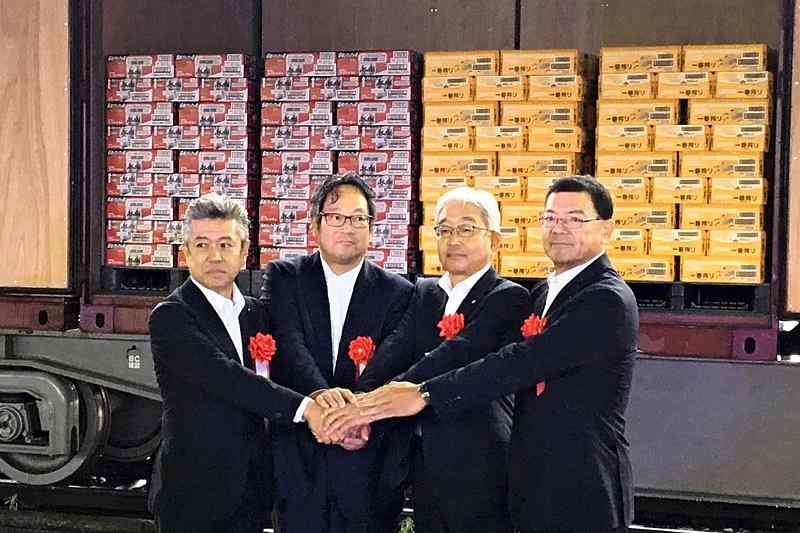
Regional heads of the four major beer makers put their hands together before a freight train during the launch of a cooperative delivery project in Hokkaido in September 2017.
11:37 JST, April 23, 2021
The prolonged coronavirus crisis is slowly but surely reframing the once-familiar habits of people getting together in bars and pubs, chatting and hobnobbing, quaffing precious glasses of beer.
Beermakers have been trying to navigate through this by exploring new ways to reach the market. This is the third in a series to take a close look at the beer and similar beverage industry.
When Suntory Holdings Ltd. President Takeshi Niinami attended the 2020 World Economic Forum in Davos, Switzerland, he was surprised to find no plastic bottles at the venue. The incident made him aware of the necessity to take actions quickly.
“Environmental issues cannot be sidestepped,” he said.
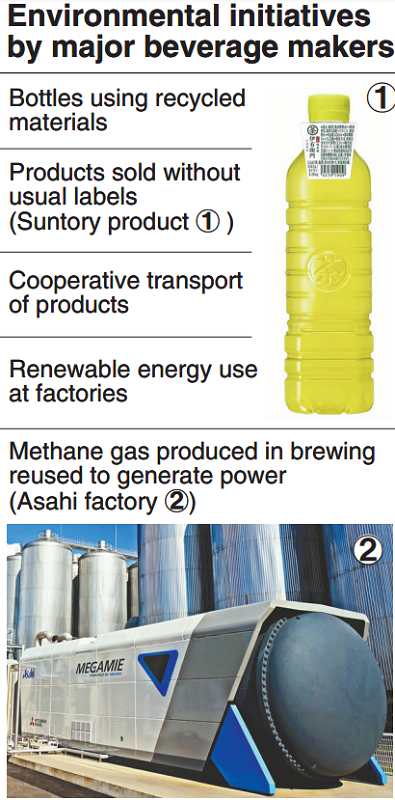
Group company Suntory Beverage & Food Ltd. has released a plastic bottle made from 100% recycled plastic, a first for its nonalcoholic beverage line. The recycled bottles are being used for its Yasashii Mugicha brand that went on sale nationwide from April 13.
“We must eliminate the negative impact of plastic on the environment,” said Tomomi Fukumoto, Suntory Holdings executive officer in charge of environment, during an online presentation of the new bottle on April 12.
Another measure the company has taken is to release a limited number of bottles of its green tea brand Iyemon without the usual label. They sold well despite the fact the product name is hardly noticeable at first glance. This was a sign that consumers were accepting the company’s environmental efforts.
Suntory’s Tennensui mineral water is also being sold in a lighter container using 40% less petroleum-derived materials.
The beverage industry has long made efforts regarding environmental issues. These companies need to be aware of water quality control in areas where their plants are located, as it directly affects the quality of their products.
Even so, rapid changes in the environment have exceeded the industry’s estimations.
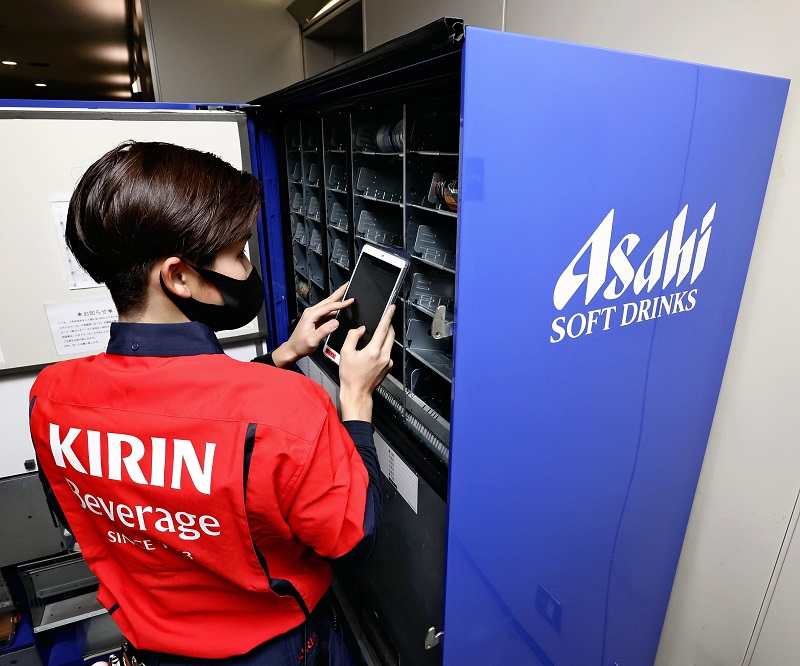
A Kirin Beverage Co. staff performs a maintenance check on a Asahi Soft Drinks Co. vending machine in Sumida Ward, Tokyo.
Drastic climate change
Rising temperatures due to global warming may reduce the supply of barley used to make beer, possibly resulting in raising the price of beer worldwide.
In December last year, an Environment Ministry report that summarized the effects of climate change pointed out that global warming is no longer somebody else’s problem. Unless serious measures are taken, dark clouds will be cast over future of beer itself.
In 2018, Asahi Group Holdings Ltd. set a goal of zero CO2 emissions in 2050, ahead of the government setting a similar target. In April this year, the company switched to renewable energy sources, such as solar and wind power, for the electricity it purchases at 19 plants in Japan, including the Ibaraki Brewery in Moriya, Ibaraki Prefecture, that produces the Super Dry brand.
“In the past, environmental efforts merely were a way to show off our performance, fulfilling our corporate social responsibilities, but now we recognize that it is part of our business, even if it is costly,” an Asahi executive said.
Kirin Brewery Co. has introduced solar power generation at four plants in Japan, including Kirin Brewery Nagoya in Kiyosu, Aichi Prefecture. The company plans to introduce solar power generation at all domestic plants in the future.
Cross-industrial cooperation
Environmental measures are costly and who funds them is a key question.
“It is essential to join hands with competitors in order not to pass on the costs to consumers,” Suntory’s Niinami said.
In 2017, Asahi, Kirin, Suntory and Sapporo Breweries Ltd. began cooperative deliveries through the sharing of rail freight containers and trucks in Hokkaido.
Beverages are heavy and require a large amount of CO2 emissions for their transport. The four makers used to ship their products individually by truck, which were usually almost empty in areas with small populations. The cooperative transport is expected to cut down the use of 800 trucks and reduce CO2 emissions by 28%.
As the project in Hokkaido was a success, this delivery method began in western Japan as well in 2018. The companies thus reduced CO2 emissions by 74%.
“We’re friendly rivals in sales but must cooperate for big issues like the environment,” a Sapporo Breweries spokesperson said.
Asahi has even outsourced the maintenance and management of its soft drink vending machines to Kirin in some areas.
Their cooperation goes beyond their industry. Since February this year, Suntory began cooperative deliveries with daily necessities maker Unicharm Corp. The two companies are pursuing efficiency by transporting heavy beverages together with light diapers and sanitary products. Their once-weekly joint transport is expected to cut CO2 emissions by two tons a year.
“Commitment to environmental initiatives has become a global imperative,” said Rakuten Securities Inc.’s chief strategist Masayuki Kubota. “Competitors must think rationally and work together because teamwork can also be better for reducing costs and addressing labor shortages.”









Most Read
Most read in the last 24 hours
-

Stepfather Reportedly Admits to Killing 11-Year-Old Boy Who Went ...
-

Trump Urges Extending Foreign Surveillance Program as Some Lawmak...
-

Iran Offers Proposal Allowing Ships to Exit Oman Side of Hormuz F...
-

S&P 500, Nasdaq Push to Closing Records on Optimism around Middle...
-

Pakistani Delegation Meets in Tehran Hoping for More US-Iran Talk...
-

Govt to Tighten Controls over Weapons after Export with New Rules...
-

Japan, US Agree to Intensify Communication on Exchange Rates
-

China's Xi Calls for Strategic Clarity, Political Security with V...
Most read in the last 7 days
-

Police Find Child's Shoe During Search for Missing Boy in Nantan,...
-

Body Found in Nantan, Kyoto Prefecture, During Search for 11-Year...
-
Japanese Prime Minister Takaichi Speaks to Pakistani Prime Minist...
-

Kyoto Police Arrests Father of 11-Year-Old Boy on Suspicion of Ab...
-

Body Found in Kyoto Pref. Forest Confirmed to Be Missing 11-Year-...
-
Strong Typhoon Sinlaku Heading Toward Tokyo's Ogasawara Islands
-

No Clear Plan for Expo Site 6 Months After Close; Delays, Unpaid ...
-
Kyoto Boy Missing for 20 Days; Largescale Search Continues in Nan...
Most read in the last 30 days
-

Mathematician Heisuke Hironaka, Winner of Fields Medal, Dies at 9...
-
Police Find Child's Shoe During Search for Missing Boy in Nantan,...
-
Body Found in Nantan, Kyoto Prefecture, During Search for 11-Year...
-

Cherry Blossoms, Rapeseed Flowers Perform Colorful ‘Duet’ in Niig...
-

New Bird Species Confirmed in Japan for 1st Time in 45 Years, Fou...
-

Nori Prices Surge in Japan Due to Poor Seaweed Production Amid Ri...
-

Earthquake Jolts Kansai Region, Recording Magnitude 4.2, Japanese...
-

Cherry Blossoms in Full Bloom Draw Crowds in Sendai, Miyagi Pref....
Top Articles in Business
-
Middle Powers Should Create Alternative to WTO, Says Research Group
-

Japan to Release Oil from National Reserve Starting Thursday
-

Luggage Storage Services in Japan Diversify in Effort to Boost ‘Hands-free’ Tourism, Address Overtourism
-

Nissan’s New Elgrand to Allow Hands-Free Driving Even in Urban Areas in Push for Domestic Market Turnaround
-

AI Development Firm Established to Develop Japanese 1-Trillion-Parameter Models, With Funding from SoftBank, NEC, Honda, Sony
JN ACCESS RANKING
-
Police Find Child’s Shoe During Search for Missing Boy in Nantan, Kyoto Prefecture
-
Body Found in Nantan, Kyoto Prefecture, During Search for 11-Year-Old Boy in Area (Update 1)
-
Cherry Blossoms, Rapeseed Flowers Perform Colorful ‘Duet’ in Niigata
-
New Bird Species Confirmed in Japan for 1st Time in 45 Years, Found on Tokara Islands in Kagoshima Pref.
-
Nori Prices Surge in Japan Due to Poor Seaweed Production Amid Rising Sea Temps; Price of Onigiri Rice Balls Also Impacted
Most read in the last 24 hours
-
Stepfather Reportedly Admits to Killing 11-Year-Old Boy Who Went ...
-
Trump Urges Extending Foreign Surveillance Program as Some Lawmak...
-
Iran Offers Proposal Allowing Ships to Exit Oman Side of Hormuz F...
-
S&P 500, Nasdaq Push to Closing Records on Optimism around Middle...
-
Pakistani Delegation Meets in Tehran Hoping for More US-Iran Talk...
Most read in the last 7 days
-
Police Find Child's Shoe During Search for Missing Boy in Nantan,...
-
Body Found in Nantan, Kyoto Prefecture, During Search for 11-Year...
-
Japanese Prime Minister Takaichi Speaks to Pakistani Prime Minist...
-
Kyoto Police Arrests Father of 11-Year-Old Boy on Suspicion of Ab...
-
Body Found in Kyoto Pref. Forest Confirmed to Be Missing 11-Year-...
Most read in the last 30 days
-
Mathematician Heisuke Hironaka, Winner of Fields Medal, Dies at 9...
-
Police Find Child's Shoe During Search for Missing Boy in Nantan,...
-
Body Found in Nantan, Kyoto Prefecture, During Search for 11-Year...
-
Cherry Blossoms, Rapeseed Flowers Perform Colorful ‘Duet’ in Niig...
-
New Bird Species Confirmed in Japan for 1st Time in 45 Years, Fou...