
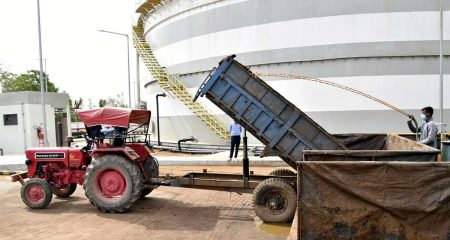
Cow dung collected from nearby farmers is transported to a Suzuki Motor Corp. plant in Gujarat State, India, on March 19.
6:00 JST, April 2, 2026
GUJARAT STATE, India — Suzuki Motor Corp. is focusing on the production of biogas derived from fermented cattle dung in India, a key market for the company.
The goal is to use this biogas as fuel for compressed natural gas vehicles, which emit fewer exhaust gases than gasoline-powered vehicles. CNG vehicles are becoming increasingly widespread in India, and Suzuki aims to capitalize on market growth by expanding its business to include fuel supply.
On March 19, cow dung collected from nearby farmers was delivered to Suzuki’s biogas production plant in the western Indian state of Gujarat. Biogas is generated by heating and stirring the dung inside a 9-meter-tall tank. The smell was barely noticeable unless the wind blew.
The plant began operations in January and uses up to 100 tons of cow dung per day to produce 1.5 tons of biogas. This is enough fuel for about 850 CNG vehicles to travel 60 kilometers.
Methane — a gas released into the atmosphere from cow dung — has a greenhouse effect 28 times greater than carbon dioxide, posing a barrier to decarbonization in India, a major dairy-producing nation. Recovering cow dung for biogas production not only reduces these emissions but also allows the remaining dung to be sold as organic fertilizer, making the venture more profitable.
“Increased fertilizer sales are essential for the business’ continued operation,” said Hiroyuki Yamano of Suzuki’s biogas business development division.
Suzuki currently operates two plants in India and plans to build seven more.
CNG vehicle adoption
Suzuki is advancing its biogas business due to the increasing popularity of CNG vehicles in India. In 2025, they accounted for 20% of new vehicle sales. Suzuki holds about 70% of the Indian CNG vehicle market and offers a lineup of 15 models, including compact cars and SUVs.
Due to the country’s high dependence on crude oil imports, the Indian government is leading efforts to increase the number of refueling stations for CNG vehicles, positioning them as an alternative to gasoline-powered cars. The number of stations is expected to expand to 17,000 by 2030, roughly double the 2025 figure.
While the purchase price of CNG vehicles is about 20% higher than that of gasoline vehicles, fuel costs are 40% lower. Demand for CNG taxis is particularly high due to the distance they cover.
“Because it’s cheaper, other drivers around here use CNG vehicles, too,” said Sonu Kumar, a 19-year-old taxi driver near the capital New Delhi.
Since the adoption of electric vehicles in India has not progressed as much as in China or Europe, CNG vehicles are likely to serve as a steppingstone toward decarbonization.







Most Read
Most read in the last 24 hours
-

Stepfather Reportedly Admits to Killing 11-Year-Old Boy Who Went ...
-

Trump Urges Extending Foreign Surveillance Program as Some Lawmak...
-

Iran Offers Proposal Allowing Ships to Exit Oman Side of Hormuz F...
-

S&P 500, Nasdaq Push to Closing Records on Optimism around Middle...
-

Pakistani Delegation Meets in Tehran Hoping for More US-Iran Talk...
-

Govt to Tighten Controls over Weapons after Export with New Rules...
-

Japan, US Agree to Intensify Communication on Exchange Rates
-

China's Xi Calls for Strategic Clarity, Political Security with V...
Most read in the last 7 days
-

Police Find Child's Shoe During Search for Missing Boy in Nantan,...
-

Body Found in Nantan, Kyoto Prefecture, During Search for 11-Year...
-

Japanese Prime Minister Takaichi Speaks to Pakistani Prime Minist...
-

Kyoto Police Arrests Father of 11-Year-Old Boy on Suspicion of Ab...
-

Body Found in Kyoto Pref. Forest Confirmed to Be Missing 11-Year-...
-
Strong Typhoon Sinlaku Heading Toward Tokyo's Ogasawara Islands
-

No Clear Plan for Expo Site 6 Months After Close; Delays, Unpaid ...
-
Kyoto Boy Missing for 20 Days; Largescale Search Continues in Nan...
Most read in the last 30 days
-
Mathematician Heisuke Hironaka, Winner of Fields Medal, Dies at 9...
-
Police Find Child's Shoe During Search for Missing Boy in Nantan,...
-
Body Found in Nantan, Kyoto Prefecture, During Search for 11-Year...
-

Cherry Blossoms, Rapeseed Flowers Perform Colorful ‘Duet’ in Niig...
-

New Bird Species Confirmed in Japan for 1st Time in 45 Years, Fou...
-

Nori Prices Surge in Japan Due to Poor Seaweed Production Amid Ri...
-

Earthquake Jolts Kansai Region, Recording Magnitude 4.2, Japanese...
-

Cherry Blossoms in Full Bloom Draw Crowds in Sendai, Miyagi Pref....
Top Articles in Business
-

Middle Powers Should Create Alternative to WTO, Says Research Group
-

Japan to Release Oil from National Reserve Starting Thursday
-

Luggage Storage Services in Japan Diversify in Effort to Boost ‘Hands-free’ Tourism, Address Overtourism
-

Nissan’s New Elgrand to Allow Hands-Free Driving Even in Urban Areas in Push for Domestic Market Turnaround
-

AI Development Firm Established to Develop Japanese 1-Trillion-Parameter Models, With Funding from SoftBank, NEC, Honda, Sony
JN ACCESS RANKING
-
Police Find Child’s Shoe During Search for Missing Boy in Nantan, Kyoto Prefecture
-
Body Found in Nantan, Kyoto Prefecture, During Search for 11-Year-Old Boy in Area (Update 1)
-
Cherry Blossoms, Rapeseed Flowers Perform Colorful ‘Duet’ in Niigata
-
New Bird Species Confirmed in Japan for 1st Time in 45 Years, Found on Tokara Islands in Kagoshima Pref.
-
Nori Prices Surge in Japan Due to Poor Seaweed Production Amid Rising Sea Temps; Price of Onigiri Rice Balls Also Impacted
Most read in the last 24 hours
-
Stepfather Reportedly Admits to Killing 11-Year-Old Boy Who Went ...
-
Trump Urges Extending Foreign Surveillance Program as Some Lawmak...
-
Iran Offers Proposal Allowing Ships to Exit Oman Side of Hormuz F...
-
S&P 500, Nasdaq Push to Closing Records on Optimism around Middle...
-
Pakistani Delegation Meets in Tehran Hoping for More US-Iran Talk...
Most read in the last 7 days
-
Police Find Child's Shoe During Search for Missing Boy in Nantan,...
-
Body Found in Nantan, Kyoto Prefecture, During Search for 11-Year...
-
Japanese Prime Minister Takaichi Speaks to Pakistani Prime Minist...
-
Kyoto Police Arrests Father of 11-Year-Old Boy on Suspicion of Ab...
-
Body Found in Kyoto Pref. Forest Confirmed to Be Missing 11-Year-...
Most read in the last 30 days
-
Mathematician Heisuke Hironaka, Winner of Fields Medal, Dies at 9...
-
Police Find Child's Shoe During Search for Missing Boy in Nantan,...
-
Body Found in Nantan, Kyoto Prefecture, During Search for 11-Year...
-
Cherry Blossoms, Rapeseed Flowers Perform Colorful ‘Duet’ in Niig...
-
New Bird Species Confirmed in Japan for 1st Time in 45 Years, Fou...