
Bank of Japan’s Surprising Announcement to Sell off ETFs Makes Stock Prices in Tokyo Market Wildly Fluctuate
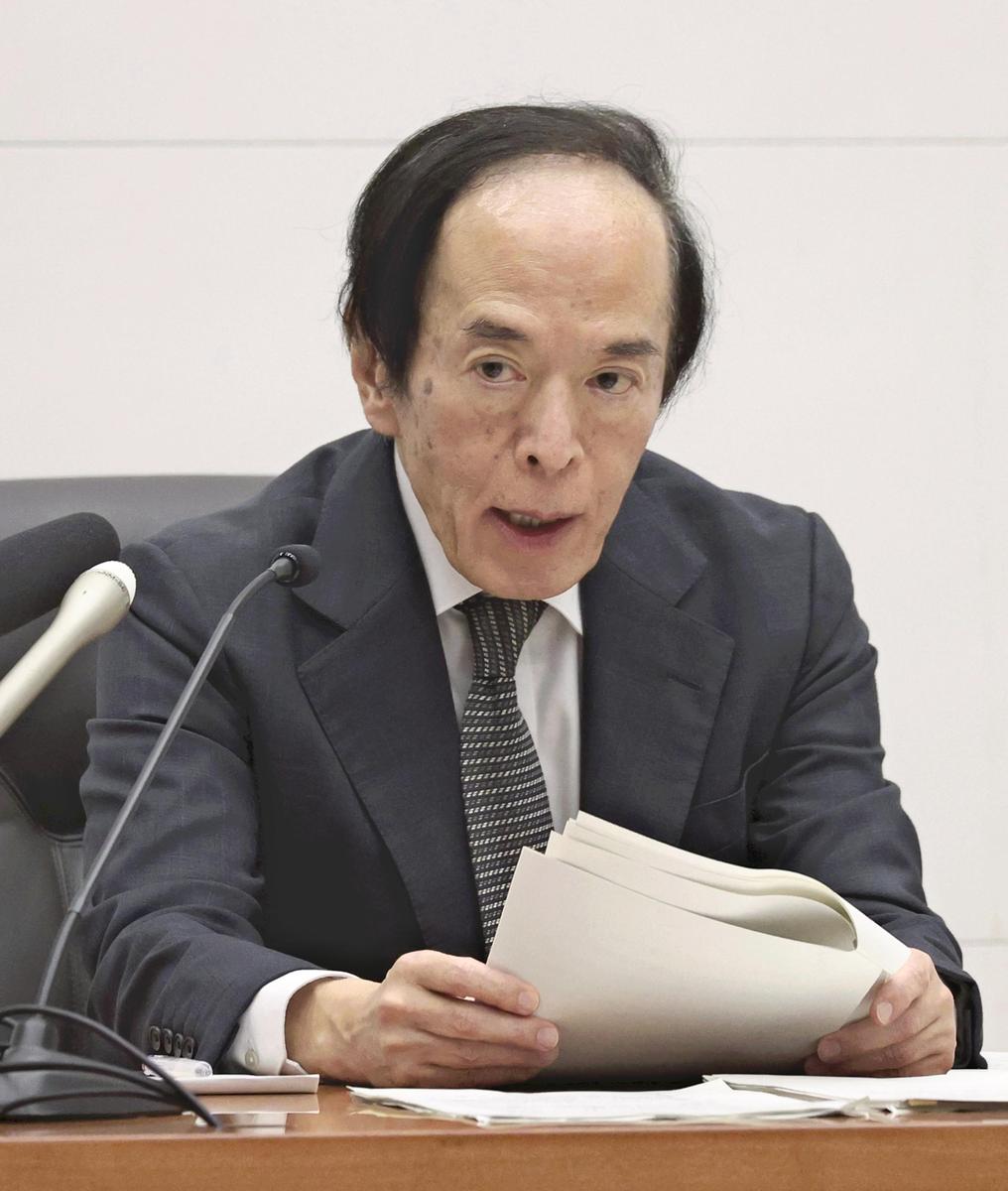
Bank of Japan Gov. Kazuo Ueda speaks at a press conference at the central bank’s headquarters in Chuo Ward, Tokyo, on Friday.
14:25 JST, September 20, 2025
In the wake of the Bank of Japan’s decision to sell off exchange-traded funds (ETFs), the Nikkei 225 stock price index of the Tokyo stock market wildly fluctuated on Friday.
The surprising announcement’s lasting effects on stock prices, which have been at record high levels, are seen to be limited. But some in the financial industry said that the BOJ’s dialogue with the private sector was insufficient regarding players in the stock market, who were caught off guard by the sudden announcement.
Panic selling
Shunsuke Kobayashi, an economist at Mizuho Securities Co., said: “It was a bolt from the blue. I have no other words to describe it than a surprising announcement.”
The Nikkei Stock Average 225 reached a record intraday high during the morning session on Friday, only to dive by more than 800 points from the previous day’s close at one point in the wake of the BOJ’s announcement.
The range of the fluctuations on Friday exceeded 1,300 points.
In the Tokyo market, the announcement caused panic selling due to a feeling that stock prices might have been overheated. An official of a major securities company said the stocks were “sold in a mechanical manner.”
However, a sense of relief from the fact that the quantities of ETFs to be sold by the BOJ will be small limited the extent of the fall. The close on the day was 45,045.81, down by 257.62 points.
Trading volume in the Tokyo Stock Exchange’s Prime section increased about 80% from the previous day to ¥8.75 trillion, marking the largest ever single-day figure since the TSE changed its trading section categories for listed companies in April 2022.
The BOJ’s plan to sell about ¥330 billion a year is based on the precedent of the BOJ having sold stocks, which it had purchased from financial institutions, since 2016 without causing confusion in the stock market.
At a press conference, BOJ Gov. Kazuo Ueda expressed consideration for the stock market by saying, “It is appropriate to gradually sell [ETFs] little by little so that disruptive effects on the market will be avoided as far as possible.”
Insufficient dialogue with market
The BOJ decided to sell ETFs because it aims to normalize monetary policy while stock prices have been hovering at high levels.
In 2010 after the global financial crisis known in Japan as the Lehman Shock, the BOJ began purchasing ETFs to prevent excessive falls in stock prices.
After Haruhiko Kuroda became the BOJ governor in 2013, the central bank expanded the amount of its ETF purchases continuously.
Ayaka Nakamura, a research fellow of the Daiwa Institute of Research, pointed out, “An expectation that the BOJ would prop up [stock prices] even if market conditions were to worsen, led to a sense of security for purchasing Japanese stocks among foreign investors.”
However, as the expanded purchases of the ETFs indirectly made the BOJ into a shareholder in private companies, some economists have been strongly critical, saying the situation could distort corporate governance.
The total book value of the ETFs held by the BOJ rose to about ¥37 trillion, accounting for 7% to 8% of the aggregate market value on the Prime section of the TSE.
When the BOJ ended its negative interest rate policy in March 2024, it decided to discontinue new purchases of ETFs. Thus, many market players assumed that the BOJ would start to sell off the ETFs. This could mean that its effect on stock prices may be limited because it was an already predicted course of action.
But seeing the large fluctuation of stock prices following the actual announcement, Nakamura said, “It could have been better if [the BOJ] had more careful communication [with the market].”









Most Read
Most read in the last 24 hours
-

Stepfather Reportedly Admits to Killing 11-Year-Old Boy Who Went ...
-

Trump Urges Extending Foreign Surveillance Program as Some Lawmak...
-

Iran Offers Proposal Allowing Ships to Exit Oman Side of Hormuz F...
-

S&P 500, Nasdaq Push to Closing Records on Optimism around Middle...
-

Pakistani Delegation Meets in Tehran Hoping for More US-Iran Talk...
-

Govt to Tighten Controls over Weapons after Export with New Rules...
-

Japan, US Agree to Intensify Communication on Exchange Rates
-

China's Xi Calls for Strategic Clarity, Political Security with V...
Most read in the last 7 days
-
Police Find Child's Shoe During Search for Missing Boy in Nantan,...
-

Body Found in Nantan, Kyoto Prefecture, During Search for 11-Year...
-
Japanese Prime Minister Takaichi Speaks to Pakistani Prime Minist...
-

Kyoto Police Arrests Father of 11-Year-Old Boy on Suspicion of Ab...
-

Body Found in Kyoto Pref. Forest Confirmed to Be Missing 11-Year-...
-
Strong Typhoon Sinlaku Heading Toward Tokyo's Ogasawara Islands
-

No Clear Plan for Expo Site 6 Months After Close; Delays, Unpaid ...
-
Kyoto Boy Missing for 20 Days; Largescale Search Continues in Nan...
Most read in the last 30 days
-
Mathematician Heisuke Hironaka, Winner of Fields Medal, Dies at 9...
-
Police Find Child's Shoe During Search for Missing Boy in Nantan,...
-
Body Found in Nantan, Kyoto Prefecture, During Search for 11-Year...
-

Cherry Blossoms, Rapeseed Flowers Perform Colorful ‘Duet’ in Niig...
-

New Bird Species Confirmed in Japan for 1st Time in 45 Years, Fou...
-

Nori Prices Surge in Japan Due to Poor Seaweed Production Amid Ri...
-

Earthquake Jolts Kansai Region, Recording Magnitude 4.2, Japanese...
-

Cherry Blossoms in Full Bloom Draw Crowds in Sendai, Miyagi Pref....
Top Articles in Business
-

Middle Powers Should Create Alternative to WTO, Says Research Group
-

Japan to Release Oil from National Reserve Starting Thursday
-

Luggage Storage Services in Japan Diversify in Effort to Boost ‘Hands-free’ Tourism, Address Overtourism
-

Nissan’s New Elgrand to Allow Hands-Free Driving Even in Urban Areas in Push for Domestic Market Turnaround
-

AI Development Firm Established to Develop Japanese 1-Trillion-Parameter Models, With Funding from SoftBank, NEC, Honda, Sony
JN ACCESS RANKING
-
Police Find Child’s Shoe During Search for Missing Boy in Nantan, Kyoto Prefecture
-
Body Found in Nantan, Kyoto Prefecture, During Search for 11-Year-Old Boy in Area (Update 1)
-
Cherry Blossoms, Rapeseed Flowers Perform Colorful ‘Duet’ in Niigata
-
New Bird Species Confirmed in Japan for 1st Time in 45 Years, Found on Tokara Islands in Kagoshima Pref.
-
Nori Prices Surge in Japan Due to Poor Seaweed Production Amid Rising Sea Temps; Price of Onigiri Rice Balls Also Impacted
Most read in the last 24 hours
-
Stepfather Reportedly Admits to Killing 11-Year-Old Boy Who Went ...
-
Trump Urges Extending Foreign Surveillance Program as Some Lawmak...
-
Iran Offers Proposal Allowing Ships to Exit Oman Side of Hormuz F...
-
S&P 500, Nasdaq Push to Closing Records on Optimism around Middle...
-
Pakistani Delegation Meets in Tehran Hoping for More US-Iran Talk...
Most read in the last 7 days
-
Police Find Child's Shoe During Search for Missing Boy in Nantan,...
-
Body Found in Nantan, Kyoto Prefecture, During Search for 11-Year...
-
Japanese Prime Minister Takaichi Speaks to Pakistani Prime Minist...
-
Kyoto Police Arrests Father of 11-Year-Old Boy on Suspicion of Ab...
-
Body Found in Kyoto Pref. Forest Confirmed to Be Missing 11-Year-...
Most read in the last 30 days
-
Mathematician Heisuke Hironaka, Winner of Fields Medal, Dies at 9...
-
Police Find Child's Shoe During Search for Missing Boy in Nantan,...
-
Body Found in Nantan, Kyoto Prefecture, During Search for 11-Year...
-
Cherry Blossoms, Rapeseed Flowers Perform Colorful ‘Duet’ in Niig...
-
New Bird Species Confirmed in Japan for 1st Time in 45 Years, Fou...