
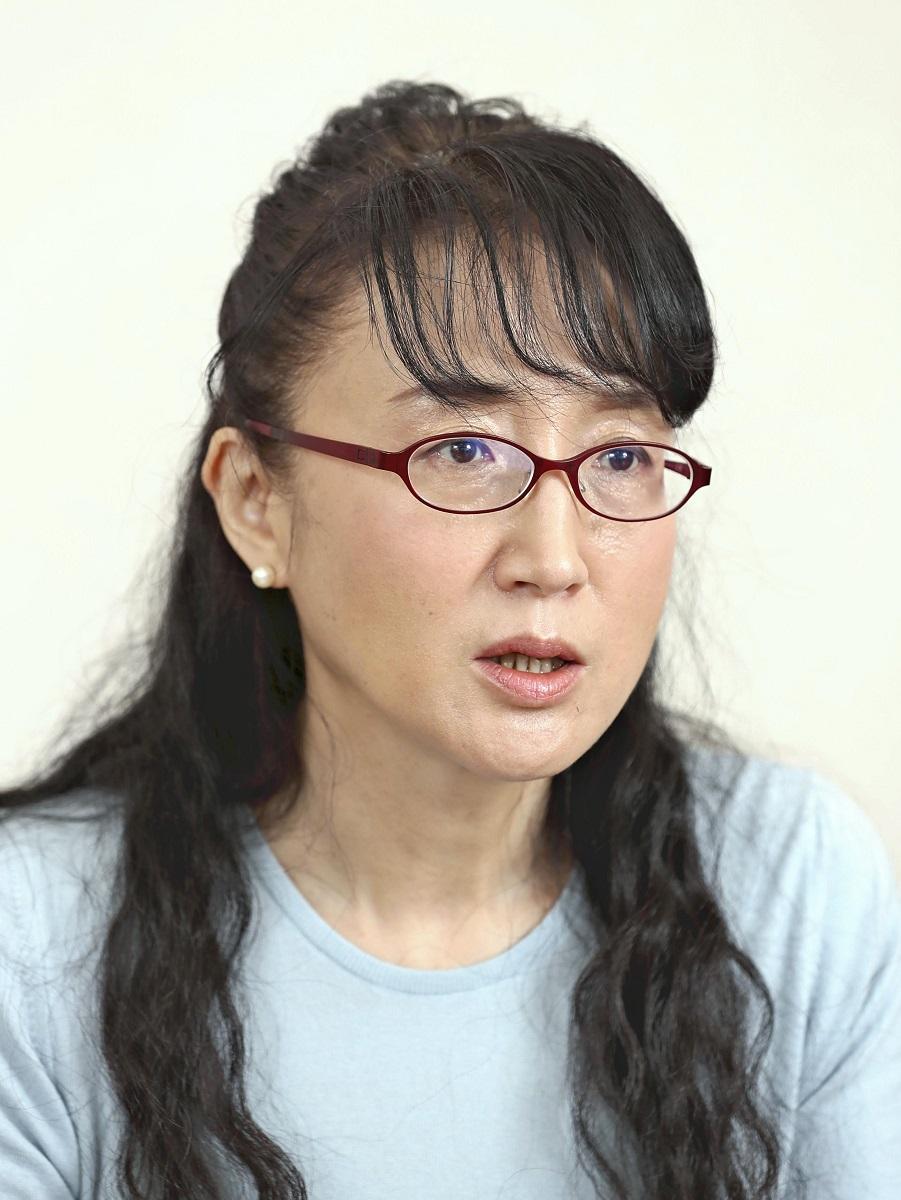
Yu Miri
18:22 JST, March 4, 2021
Ahead of the 10th anniversary of the Great East Japan Earthquake, writer Yu Miri spoke to Yomiuri Shimbun Staff Writer Shinya Machida in Tokyo about her connection to the disaster-hit area. The following is excerpted from the interview.
It was April 21, 2011, when I visited Fukushima Prefecture after the Great East Japan Earthquake. I wanted to see the cherry blossoms blooming in the Yonomori district in the town of Tomioka and other areas before they were designated as no-entry zones due to the nuclear power station crisis.
After that, I started commuting to Minami-Soma in Fukushima Prefecture from Kamakura [in Kanagawa Prefecture], where I was living at the time. In 2012, I started hosting a program called “Futari to Hitori” (Two and one) on temporary disaster radio station Minami-Soma Hibari FM, in which I listened to the stories of local people.
I have listened to 600 people in total, including schoolteachers and people who lost family members. When I cried while listening to a woman who lost her parents in Onagawa, Miyagi Prefecture, she told me not to let my tears be the end of the story. I felt responsibility in listening to her story.
In 2015, I moved to Minami-Soma. After a while, I felt that my inner self was unraveling.
As a Korean resident in Japan, I was obsessed with the existence of “me” when I was young. I was writing novels in the midst of a “self hell,” in which I felt like I was waiting for myself even after running away from my own heavy, distorted self.
But I fell apart after I heard the stories of many people in the disaster-stricken area. What came out of the experience was “Tokyo Ueno Station,” which won the U.S. National Book Foundation’s National Book Award for Translated Literature.
I had thought that people overseas would like to read stateless works that could be easily translated into any language or easily understood in any country. But I received the award for [my novel that tells] a local story featuring a man from the Yasawa district in Kashima Ward, Minami-Soma.
I currently run a bookstore called Full House in Odaka Ward, Minami-Soma. The owner of a nearby fish shop would come to my store to buy a period novel, and a person who was a worker of some kind would purchase a thick book because there was no TV in his dormitory.
There are “people” living in books. I feel that meeting others in a book is more important for many people when it is difficult to interact with others due to the influence of the coronavirus pandemic.
Since I was 18 years old, I have consistently written for “people who have no place to go.” In the areas affected by the Great East Japan Earthquake 10 years ago, and now the pandemic, there are many people who can easily fall beyond loneliness with just one wrong step. As their children and grandchildren who used to live with them have left for the cities, some elderly people live alone. We should not forget that for people in Fukushima, this is the second time that they have had to wear masks and stay confined indoors. The first was the nuclear accident in 2011.
On Feb. 13 this year, an earthquake registering a maximum intensity of upper 6 on the Japanese seismic scale hit off the coast of Fukushima Prefecture. After an inspection by the Minami-Soma city office, I received a certificate of quake damage for my house. It says my house was partially damaged. If we had been hit by such a strong tremor at a mealtime, when we were cooking and eating, many fires might have occurred.
For the next 10 years, I want to reweave my unraveled self and write novels.







Most Read
Most read in the last 24 hours
-

Stepfather Reportedly Admits to Killing 11-Year-Old Boy Who Went ...
-

Trump Urges Extending Foreign Surveillance Program as Some Lawmak...
-

Iran Offers Proposal Allowing Ships to Exit Oman Side of Hormuz F...
-

Pakistani Delegation Meets in Tehran Hoping for More US-Iran Talk...
-

S&P 500, Nasdaq Push to Closing Records on Optimism around Middle...
-
Govt to Tighten Controls over Weapons after Export with New Rules...
-

Japan, US Agree to Intensify Communication on Exchange Rates
-

China's Xi Calls for Strategic Clarity, Political Security with V...
Most read in the last 7 days
-
Police Find Child's Shoe During Search for Missing Boy in Nantan,...
-
Body Found in Nantan, Kyoto Prefecture, During Search for 11-Year...
-

Japanese Prime Minister Takaichi Speaks to Pakistani Prime Minist...
-

Kyoto Police Arrests Father of 11-Year-Old Boy on Suspicion of Ab...
-

Body Found in Kyoto Pref. Forest Confirmed to Be Missing 11-Year-...
-
Strong Typhoon Sinlaku Heading Toward Tokyo's Ogasawara Islands
-

No Clear Plan for Expo Site 6 Months After Close; Delays, Unpaid ...
-
Kyoto Boy Missing for 20 Days; Largescale Search Continues in Nan...
Most read in the last 30 days
-
Mathematician Heisuke Hironaka, Winner of Fields Medal, Dies at 9...
-
Police Find Child's Shoe During Search for Missing Boy in Nantan,...
-
Body Found in Nantan, Kyoto Prefecture, During Search for 11-Year...
-

Cherry Blossoms, Rapeseed Flowers Perform Colorful ‘Duet’ in Niig...
-
New Bird Species Confirmed in Japan for 1st Time in 45 Years, Fou...
-
Nori Prices Surge in Japan Due to Poor Seaweed Production Amid Ri...
-

Earthquake Jolts Kansai Region, Recording Magnitude 4.2, Japanese...
-

Cherry Blossoms in Full Bloom Draw Crowds in Sendai, Miyagi Pref....
Top Articles in Culture
-

Kyoto Native Indigo Dyeing Artisan Wins Top Prize at Traditional Craft Contest for Work Made Using Local Resources
-

Japanese Anime ‘Precure’ Takes on Detective Genre in 23rd Series, Solving Mysterious Cases
-

‘Ichi the Witch’ Manga Writer, Illustrator Talk About Working Together, Creating World of 1st ‘Male Witch’
-
Kabuki Actor Nakamura Takanosuke Looking Forward to Seeing Audiences’ Reactions in Europe in His First Overseas Performances
-
Potter in Japan Concerned That Iran War Is Destroying Persian Culture
JN ACCESS RANKING
-
Police Find Child’s Shoe During Search for Missing Boy in Nantan, Kyoto Prefecture
-
Body Found in Nantan, Kyoto Prefecture, During Search for 11-Year-Old Boy in Area (Update 1)
-
Cherry Blossoms, Rapeseed Flowers Perform Colorful ‘Duet’ in Niigata
-
New Bird Species Confirmed in Japan for 1st Time in 45 Years, Found on Tokara Islands in Kagoshima Pref.
-
Nori Prices Surge in Japan Due to Poor Seaweed Production Amid Rising Sea Temps; Price of Onigiri Rice Balls Also Impacted
Most read in the last 24 hours
-
Stepfather Reportedly Admits to Killing 11-Year-Old Boy Who Went ...
-
Trump Urges Extending Foreign Surveillance Program as Some Lawmak...
-
Iran Offers Proposal Allowing Ships to Exit Oman Side of Hormuz F...
-
Pakistani Delegation Meets in Tehran Hoping for More US-Iran Talk...
-
S&P 500, Nasdaq Push to Closing Records on Optimism around Middle...
Most read in the last 7 days
-
Police Find Child's Shoe During Search for Missing Boy in Nantan,...
-
Body Found in Nantan, Kyoto Prefecture, During Search for 11-Year...
-
Japanese Prime Minister Takaichi Speaks to Pakistani Prime Minist...
-
Kyoto Police Arrests Father of 11-Year-Old Boy on Suspicion of Ab...
-
Body Found in Kyoto Pref. Forest Confirmed to Be Missing 11-Year-...
Most read in the last 30 days
-
Mathematician Heisuke Hironaka, Winner of Fields Medal, Dies at 9...
-
Police Find Child's Shoe During Search for Missing Boy in Nantan,...
-
Body Found in Nantan, Kyoto Prefecture, During Search for 11-Year...
-
Cherry Blossoms, Rapeseed Flowers Perform Colorful ‘Duet’ in Niig...
-
New Bird Species Confirmed in Japan for 1st Time in 45 Years, Fou...