
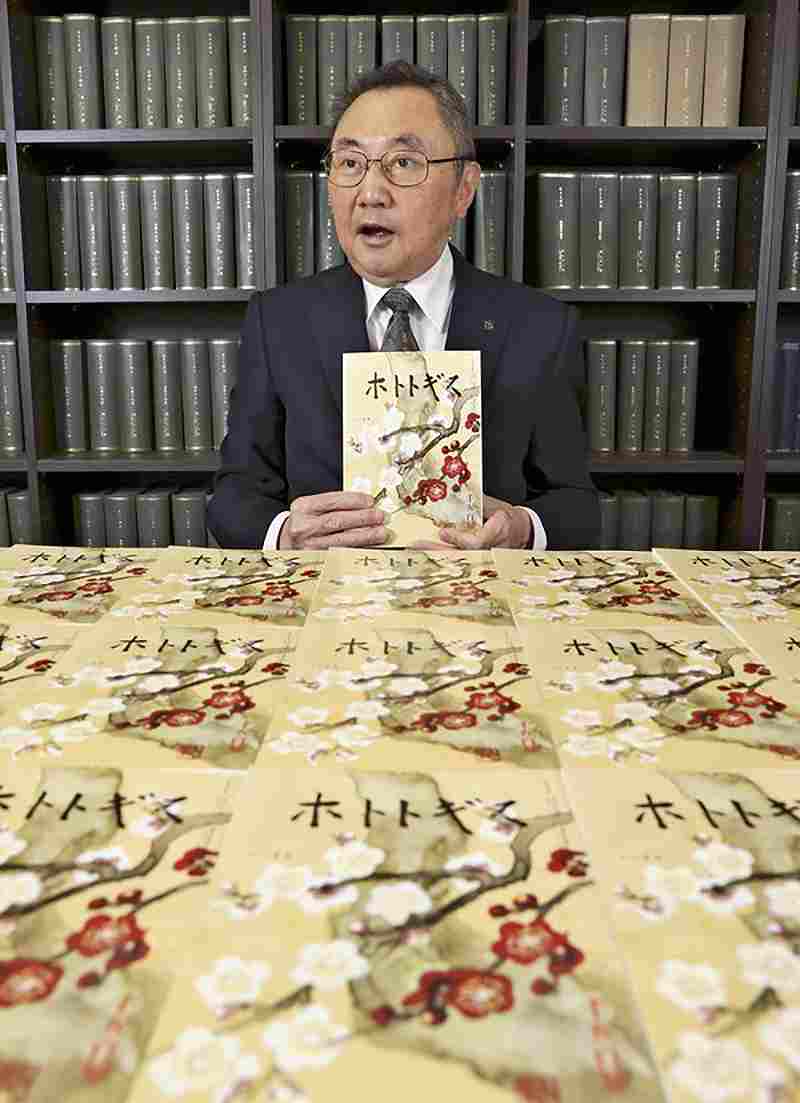
Kotaro Inahata poses with the 1,500th issue of haiku magazine Hototogisu in Chiyoda Ward, Tokyo.
19:20 JST, December 23, 2021
Haiku magazine Hototogisu, which means cuckoo bird, celebrated its 1,500th installment with the release of its December 2021 issue.
Launched in 1897, Hototogisu continues to enjoy a loyal readership after nearly 125 years in print, as the nation’s longest-running periodical source of haiku in the spirit of foundational poets Shiki Masaoka and Kyoshi Takahama.
On Nov. 17, Hototogisu’s director Kotaro Inahata proudly held up an advance copy of the landmark issue, fresh from the printer.
“Throughout our long history as the longest-running haiku magazine in Japan, Hototogisu has served as guardian of the ‘Kacho Fuei’ ideal,” said Inahata.
He was referring to a philosophy developed by his great-grandfather, Kyoshi, who was a proponent of haiku that captured the changing seasons, as well as the concord between nature and the human world.
“We’ve tended to cater to older readers, but in recent years, have been fielding more submissions from younger people, even some elementary school students,” he said.
Hototogisu was founded in the Ehime capital Matsuyama in January 1897 by Kyokudo Yanagihara, a close friend of Shiki. When the monthly magazine’s offices moved to Tokyo the following year, the editorial reins passed to Kyoshi.
By this time, Hototogisu had already begun to attract a wide readership for fare that spanned selected poems as well as prose by Shiki, Kyoshi, and others. But it was the publication of modernist fiction by a then relatively-unknown Soseki Natsume that propelled the magazine to preeminence on the popular literary landscape.
In January 1905, the magazine began serializing Soseki’s satirical novel “I Am a Cat,” which was written at the suggestion of Kyoshi. Soseki followed this breakthrough hit with “Botchan,” another seminal novel that helped sell 8,000 copies of Hototogisu when it debuted in the magazine in 1906.
The magazine subsequently shifted its focus back to haiku with an emphasis on seasonal themes and the 5-7-5 syllable pattern that cemented Hototogisu’s standing in the haiku world.
Over the decades, leading Japanese painters such as Taikan Yokoyama and Kaii Higashiyama contributed cover art that visually expressed the “Kacho Fuei” aesthetic.
During World War II, the magazine featured poems penned by soldiers from the southern front:
The soldiers slumber
in the shelter of shadows
strewn on the ship deck
Papaya flowers
in the quiet afternoon
o’er a hushed camp
Apart from a short hiatus around the end of the war, the magazine has remained in continuous publication under the direction of Kyoshi’s descendants.
Kyoshi entrusted the magazine to his eldest son, the late Toshio Takahama, who in turn handed the baton to his second daughter, Teiko Inahata, now 90, in the middle of the Showa era (1926-1989). When the magazine published its 1,100th issue in 1988, circulation stood at around 10,000 copies.
Although monthly circulation now hovers closer to 2,500 copies, readers can still submit their own haiku poems for publication, using a form bound into the back of the magazine.
As incumbent director, Kotaro Inahata said he peruses nearly 6,000 original poems sent to the Chidoya Ward, Tokyo offices of Hototogisu Co. each month for publication in the magazine.
Hototogisu continues to evolve in the digital age through new initiatives, including online haiku events.
“Going forward, I hope to remain true to tradition, while also conveying the great appeal of haiku and Hototogisu to the young generation,” Inahata said.






Most Read
Most read in the last 24 hours
-

Stepfather Reportedly Admits to Killing 11-Year-Old Boy Who Went ...
-

Trump Urges Extending Foreign Surveillance Program as Some Lawmak...
-

Iran Offers Proposal Allowing Ships to Exit Oman Side of Hormuz F...
-

S&P 500, Nasdaq Push to Closing Records on Optimism around Middle...
-

Pakistani Delegation Meets in Tehran Hoping for More US-Iran Talk...
-

Govt to Tighten Controls over Weapons after Export with New Rules...
-

Japan, US Agree to Intensify Communication on Exchange Rates
-

China's Xi Calls for Strategic Clarity, Political Security with V...
Most read in the last 7 days
-

Police Find Child's Shoe During Search for Missing Boy in Nantan,...
-

Body Found in Nantan, Kyoto Prefecture, During Search for 11-Year...
-

Japanese Prime Minister Takaichi Speaks to Pakistani Prime Minist...
-

Kyoto Police Arrests Father of 11-Year-Old Boy on Suspicion of Ab...
-

Body Found in Kyoto Pref. Forest Confirmed to Be Missing 11-Year-...
-
Strong Typhoon Sinlaku Heading Toward Tokyo's Ogasawara Islands
-

No Clear Plan for Expo Site 6 Months After Close; Delays, Unpaid ...
-
Kyoto Boy Missing for 20 Days; Largescale Search Continues in Nan...
Most read in the last 30 days
-

Mathematician Heisuke Hironaka, Winner of Fields Medal, Dies at 9...
-
Police Find Child's Shoe During Search for Missing Boy in Nantan,...
-
Body Found in Nantan, Kyoto Prefecture, During Search for 11-Year...
-

Cherry Blossoms, Rapeseed Flowers Perform Colorful ‘Duet’ in Niig...
-
New Bird Species Confirmed in Japan for 1st Time in 45 Years, Fou...
-

Nori Prices Surge in Japan Due to Poor Seaweed Production Amid Ri...
-

Earthquake Jolts Kansai Region, Recording Magnitude 4.2, Japanese...
-

Cherry Blossoms in Full Bloom Draw Crowds in Sendai, Miyagi Pref....
Top Articles in Culture
-

Kyoto Native Indigo Dyeing Artisan Wins Top Prize at Traditional Craft Contest for Work Made Using Local Resources
-

Japanese Anime ‘Precure’ Takes on Detective Genre in 23rd Series, Solving Mysterious Cases
-

‘Ichi the Witch’ Manga Writer, Illustrator Talk About Working Together, Creating World of 1st ‘Male Witch’
-
Kabuki Actor Nakamura Takanosuke Looking Forward to Seeing Audiences’ Reactions in Europe in His First Overseas Performances
-

Potter in Japan Concerned That Iran War Is Destroying Persian Culture
JN ACCESS RANKING
-
Police Find Child’s Shoe During Search for Missing Boy in Nantan, Kyoto Prefecture
-
Body Found in Nantan, Kyoto Prefecture, During Search for 11-Year-Old Boy in Area (Update 1)
-
Cherry Blossoms, Rapeseed Flowers Perform Colorful ‘Duet’ in Niigata
-
New Bird Species Confirmed in Japan for 1st Time in 45 Years, Found on Tokara Islands in Kagoshima Pref.
-
Nori Prices Surge in Japan Due to Poor Seaweed Production Amid Rising Sea Temps; Price of Onigiri Rice Balls Also Impacted
Most read in the last 24 hours
-
Stepfather Reportedly Admits to Killing 11-Year-Old Boy Who Went ...
-
Trump Urges Extending Foreign Surveillance Program as Some Lawmak...
-
Iran Offers Proposal Allowing Ships to Exit Oman Side of Hormuz F...
-
S&P 500, Nasdaq Push to Closing Records on Optimism around Middle...
-
Pakistani Delegation Meets in Tehran Hoping for More US-Iran Talk...
Most read in the last 7 days
-
Police Find Child's Shoe During Search for Missing Boy in Nantan,...
-
Body Found in Nantan, Kyoto Prefecture, During Search for 11-Year...
-
Japanese Prime Minister Takaichi Speaks to Pakistani Prime Minist...
-
Kyoto Police Arrests Father of 11-Year-Old Boy on Suspicion of Ab...
-
Body Found in Kyoto Pref. Forest Confirmed to Be Missing 11-Year-...
Most read in the last 30 days
-
Mathematician Heisuke Hironaka, Winner of Fields Medal, Dies at 9...
-
Police Find Child's Shoe During Search for Missing Boy in Nantan,...
-
Body Found in Nantan, Kyoto Prefecture, During Search for 11-Year...
-
Cherry Blossoms, Rapeseed Flowers Perform Colorful ‘Duet’ in Niig...
-
New Bird Species Confirmed in Japan for 1st Time in 45 Years, Fou...