
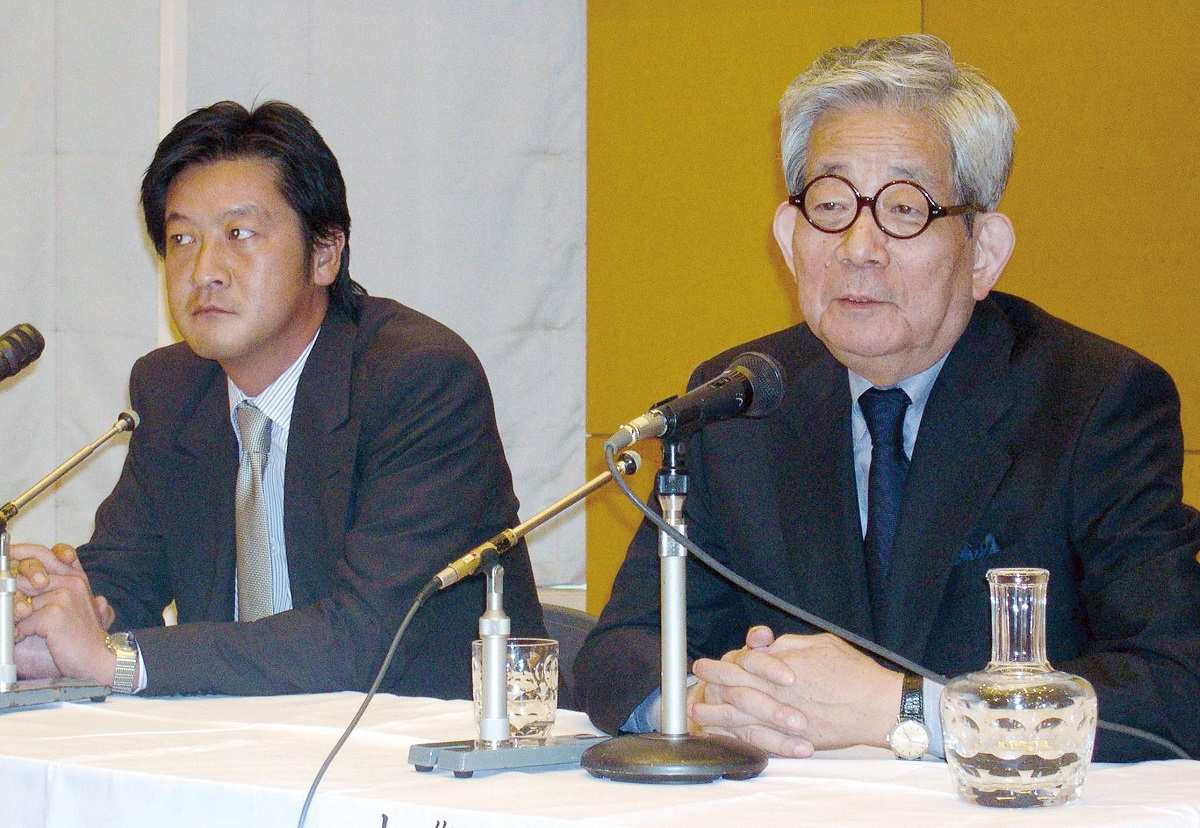
Kenzaburo Oe, right, announces the establishment of the Kenzaburo Oe Prize, with Yoshinobu Noma, then vice president of Kodansha Ltd., in October 2005.
11:20 JST, April 6, 2023
Kenzaburo Oe, the second Japanese writer to win the Nobel Prize in Literature, died at age 88 last month, leaving behind a number of masterpieces that will forever be a part of Japan’s literary canon, including “Kojintekina Taiken” (“A Personal Matter”) and “Manen Gannen no Futtoboru” (“The Silent Cry”).
“Although both [Kenzaburo Oe and Yukio Mishima] were overwhelming talents, Mishima’s literature stirred a strong admiration in me, while reading Oe’s works made me totally lose confidence in my ability,” writer Keiichiro Hirano, 47, said on March 13, the day Oe’s death was first reported. “I felt novels should be written by someone like Oe.”
Hirano says that he was influenced by Oe’s “The Silent Cry” when writing “Kekkai” (“Breach”). Both Hirano and Oe won the prestigious Akutagawa Prize in their early 20s.
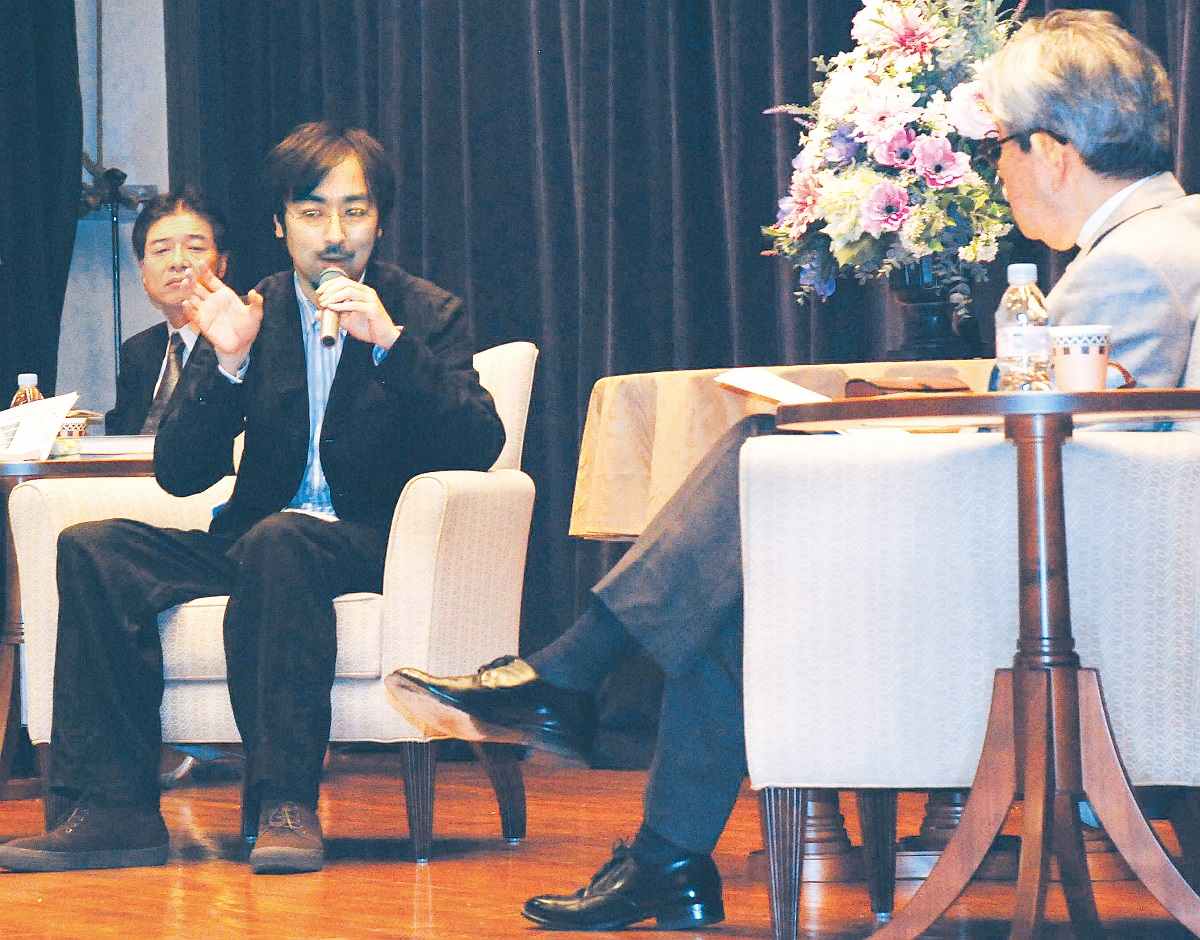
Oe, right, with Yu Nagashima, the first recipient of the Kenzaburo Oe Prize, in May 2007. Winners of the prize were able to converse with Oe at a public event.
“What does a writer who debuts so early write by the age of 30 or so?” Hirano said. “What from the period they live in causes them to suffer, and what do they try to overcome? I felt a difference of time period and place between us. Since I grew up in an industrial city, I lacked a world like that of Oe’s Shikoku forests, which was such a boon to his construction of mythical spaces.”
“His tense style of writing that shakes the reader’s very existence is sensational,” he added.
Oe’s influence runs deep for today’s writers. In part, this is due to the Kenzaburo Oe Prize, a literary award for which Oe was the sole judge. The prize was given to eight writers from 2007 to 2014 — starting with Yu Nagashima, 50, for his “Yuko-chan no Chikamichi” (Yuko’s shortcut) — and the award-winning works were translated abroad.
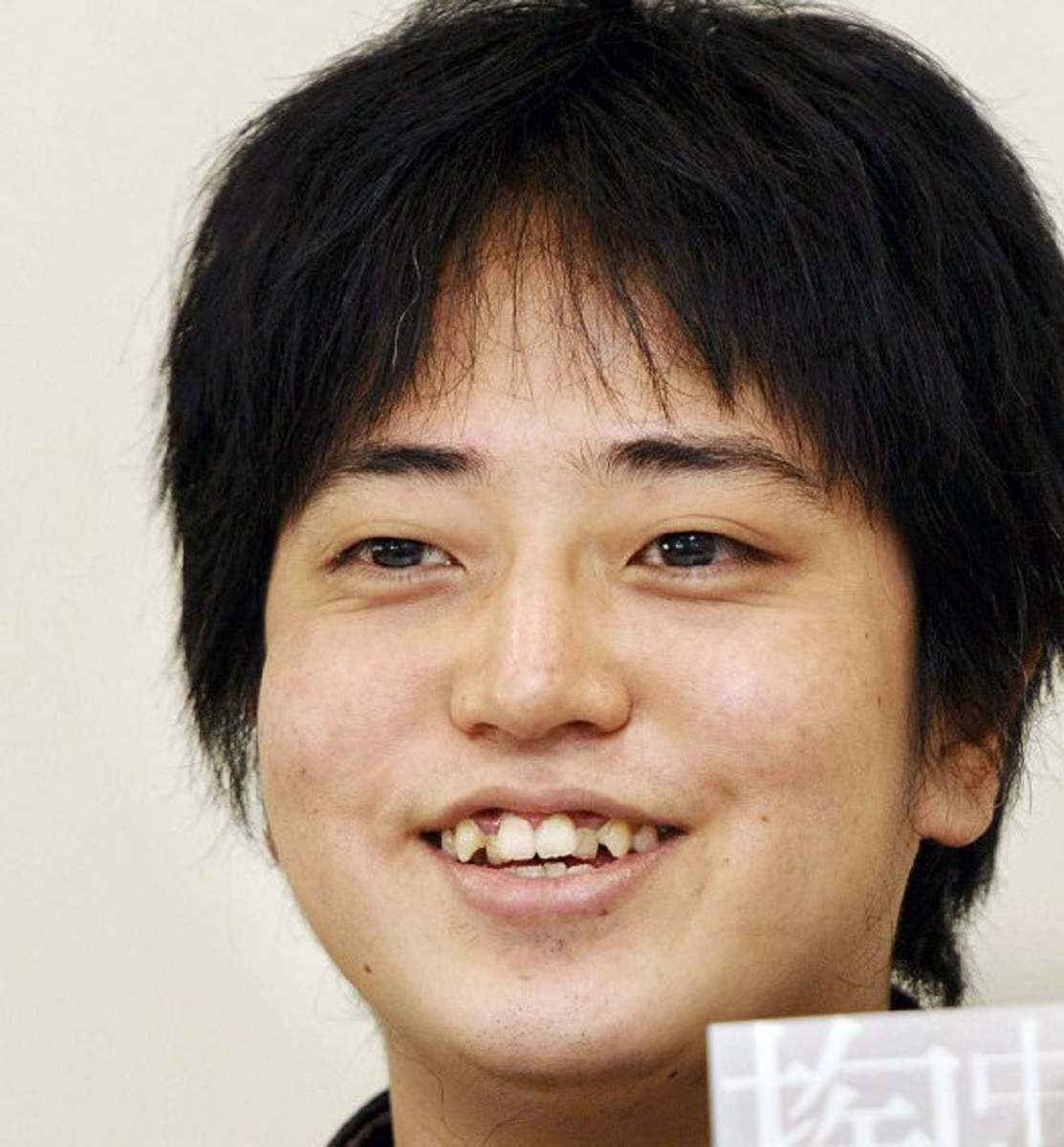
Fuminori Nakamura.
Fuminori Nakamura, 45, one of the award winners, said: “Oe’s works, with their profound depictions of the human psyche and their protagonists who experience something dark but keep living, encouraged me. I had dreamed of people abroad reading my works, and after I received the Oe Prize for ‘Suri’ (‘The Thief’), it got translated. This opened my way to the world stage. He saved me as a reader and supported me as a writer.”
At age 80, Oe stopped writing. In his 70s, the final stage of his writing career, he seemed especially eager to inspire younger writers. No doubt Oe, who knew how reading and writing books could bring people together, was trying to pass the novelist’s baton.
Writing and, above all, reading were central for Oe. He said that “a serious reader is someone who rereads,” and he himself would read the same book many times over.
This approach stemmed from his childhood in the countryside of Ehime Prefecture. During the difficult period spanning World War II and the postwar era, a young Oe was absorbed in reading two books that his mother had obtained: “The Wonderful Adventures of Nils” and “Adventures of Huckleberry Finn.” These awakened him to the joy of novels.
In high school, Oe was so impressed by the writings of Kazuo Watanabe on French Renaissance culture that he decided to study French literature at the University of Tokyo, where Watanabe taught.
Having entered the university, Oe was able to study under Watanabe, and he felt keenly the power of books to form human connections.
When interviewed at his home in Tokyo in 2014, Oe, foreign-influenced writer that he was, sat in front of a bookshelf full of Japanese and foreign books.
“As I read and wrote more and more, these things became a habit, and my experiences helped me to overcome difficulties,” he said. “These experiences have created the writer, the human being that I am.”
Oe, with his childhood shaped by the war, may have chosen in the postwar era to live a life of reading, writing and being guided by literature because this was the farthest thing from militarism.
He experienced a number of difficulties throughout his life, such as his son being born with disabilities and the challenge of learning to live with him, the fear of nuclear weapons and resentment toward a world with constant wars. He overcame these troubles by ceaseless reading, writing and interaction with others.
“Oe was an important writer of my generation, but his attitude toward reality and history was somehow different from other writers,” said writer Senji Kuroi, 90. “I felt a different sort of scale in his work, which broadly and deeply explored what it means to be human through the medium of literature.”
Now these literary probings, as well as Oe’s approach to life itself, are being inherited by the next generation.







Most Read
Most read in the last 24 hours
-

Stepfather Reportedly Admits to Killing 11-Year-Old Boy Who Went ...
-

Trump Urges Extending Foreign Surveillance Program as Some Lawmak...
-

Iran Offers Proposal Allowing Ships to Exit Oman Side of Hormuz F...
-

Pakistani Delegation Meets in Tehran Hoping for More US-Iran Talk...
-

S&P 500, Nasdaq Push to Closing Records on Optimism around Middle...
-

Govt to Tighten Controls over Weapons after Export with New Rules...
-

Japan, US Agree to Intensify Communication on Exchange Rates
-

China's Xi Calls for Strategic Clarity, Political Security with V...
Most read in the last 7 days
-
Police Find Child's Shoe During Search for Missing Boy in Nantan,...
-

Body Found in Nantan, Kyoto Prefecture, During Search for 11-Year...
-

Japanese Prime Minister Takaichi Speaks to Pakistani Prime Minist...
-

Kyoto Police Arrests Father of 11-Year-Old Boy on Suspicion of Ab...
-

Body Found in Kyoto Pref. Forest Confirmed to Be Missing 11-Year-...
-
Strong Typhoon Sinlaku Heading Toward Tokyo's Ogasawara Islands
-

No Clear Plan for Expo Site 6 Months After Close; Delays, Unpaid ...
-
Kyoto Boy Missing for 20 Days; Largescale Search Continues in Nan...
Most read in the last 30 days
-
Mathematician Heisuke Hironaka, Winner of Fields Medal, Dies at 9...
-
Police Find Child's Shoe During Search for Missing Boy in Nantan,...
-
Body Found in Nantan, Kyoto Prefecture, During Search for 11-Year...
-

Cherry Blossoms, Rapeseed Flowers Perform Colorful ‘Duet’ in Niig...
-

New Bird Species Confirmed in Japan for 1st Time in 45 Years, Fou...
-

Nori Prices Surge in Japan Due to Poor Seaweed Production Amid Ri...
-

Earthquake Jolts Kansai Region, Recording Magnitude 4.2, Japanese...
-

Cherry Blossoms in Full Bloom Draw Crowds in Sendai, Miyagi Pref....
Top Articles in Culture
-

Kyoto Native Indigo Dyeing Artisan Wins Top Prize at Traditional Craft Contest for Work Made Using Local Resources
-

Japanese Anime ‘Precure’ Takes on Detective Genre in 23rd Series, Solving Mysterious Cases
-

‘Ichi the Witch’ Manga Writer, Illustrator Talk About Working Together, Creating World of 1st ‘Male Witch’
-
Kabuki Actor Nakamura Takanosuke Looking Forward to Seeing Audiences’ Reactions in Europe in His First Overseas Performances
-

Potter in Japan Concerned That Iran War Is Destroying Persian Culture
JN ACCESS RANKING
-
Police Find Child’s Shoe During Search for Missing Boy in Nantan, Kyoto Prefecture
-
Body Found in Nantan, Kyoto Prefecture, During Search for 11-Year-Old Boy in Area (Update 1)
-
Cherry Blossoms, Rapeseed Flowers Perform Colorful ‘Duet’ in Niigata
-
New Bird Species Confirmed in Japan for 1st Time in 45 Years, Found on Tokara Islands in Kagoshima Pref.
-
Nori Prices Surge in Japan Due to Poor Seaweed Production Amid Rising Sea Temps; Price of Onigiri Rice Balls Also Impacted
Most read in the last 24 hours
-
Stepfather Reportedly Admits to Killing 11-Year-Old Boy Who Went ...
-
Trump Urges Extending Foreign Surveillance Program as Some Lawmak...
-
Iran Offers Proposal Allowing Ships to Exit Oman Side of Hormuz F...
-
Pakistani Delegation Meets in Tehran Hoping for More US-Iran Talk...
-
S&P 500, Nasdaq Push to Closing Records on Optimism around Middle...
Most read in the last 7 days
-
Police Find Child's Shoe During Search for Missing Boy in Nantan,...
-
Body Found in Nantan, Kyoto Prefecture, During Search for 11-Year...
-
Japanese Prime Minister Takaichi Speaks to Pakistani Prime Minist...
-
Kyoto Police Arrests Father of 11-Year-Old Boy on Suspicion of Ab...
-
Body Found in Kyoto Pref. Forest Confirmed to Be Missing 11-Year-...
Most read in the last 30 days
-
Mathematician Heisuke Hironaka, Winner of Fields Medal, Dies at 9...
-
Police Find Child's Shoe During Search for Missing Boy in Nantan,...
-
Body Found in Nantan, Kyoto Prefecture, During Search for 11-Year...
-
Cherry Blossoms, Rapeseed Flowers Perform Colorful ‘Duet’ in Niig...
-
New Bird Species Confirmed in Japan for 1st Time in 45 Years, Fou...