
Chiba Pref. Craftsman Makes Traditional Kumihimo Braided Products; He Carries on Family Business Which Started in the Edo Period
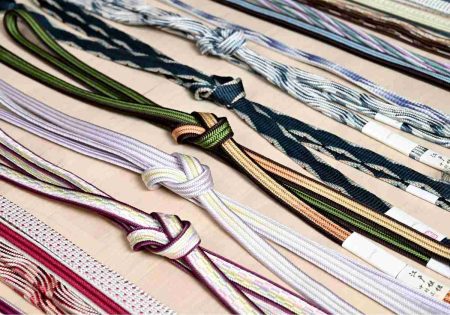
Handmade obijime cords
16:00 JST, October 12, 2025
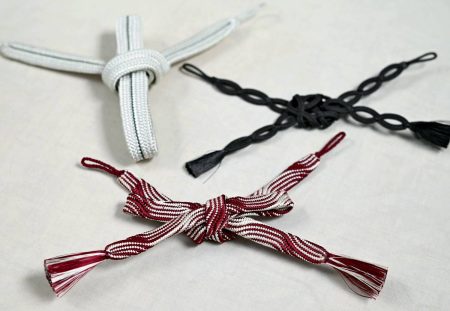
Three kinds of haorihimo
MATSUDO, Chiba — The appearance of a kimono can be enhanced by beautifully patterned obijime cords, worn over the obi sash belt, and haorihimo, which are straps for haori, half-length traditional Japanese coats.
Obijime and haorihimo are both examples of kumihimo, traditional Japanese braided products, and they are durable, supple and easy to tie, particularly when made by a skilled craftsman, which is why they are so popular among kimono wearers.
The traditional Japanese braiding technique, which produces various patterns, is believed to have been introduced to Japan along with Buddhism during the Nara period (710-784). There are said to be more than 400 basic kumihimo braiding patterns, and over 3,000 of them in all when different designs are counted.

Kota Nakamura
“[When making obijime or haorihimo] it’s important to coordinate them with the kimono. I imagine what a person will look like wearing them when I’m thinking up colors and patterns,” said Kota Nakamura, 51, the fourth-generation owner of Nakamurasho, a kumihimo company based in Matsudo, Chiba Prefecture.
The creation of obijime using kumihimo techniques begins with about 30 types of paints being mixed to create dyes. These dyes are then applied to raw silk, giving it colors such as gold, purple and green. Nakamurasho stocks threads in about 150 colors, including about 20 just in red tones.
The length of the dyed threads is then adjusted. Threads are wrapped around lead weights called tedama and wound together on a braiding stand called a kumidai. About 900 to 1,200 threads are used to make a 150- to 160-centimeter-long obijime, according to Nakamura. It takes three days to two weeks to complete an obijime cord.
Weaving a haorihimo starts with tying a loop knot. Steps such as adding threads while creating the cord require particular skills which only Nakamura and a few other people in the country possess.
Nakamura has created kumihimo haori straps for champion shogi player Sota Fujii, as well as Shishi, a professional sumo wrestler from Ukraine, at their request.
“Seeing people wearing [kumihimo haori straps I made] on TV and elsewhere makes me feel that I’m connected to society and that I’m helpful to others,” he said.
Nakamura’s great-grandfather, a kumihimo artisan from the shitamachi traditional commercial area of Tokyo, founded Nakamurasho in 1893 after moving to Matsudo, which was then a post town, a way station for travelers. Nakamura, who grew up while watching artisans, said he came to believe that it was vital to keep kumihimo techniques alive. He decided to take over running Nakamurasho when he was in his 20s.
Nakamura studied kimono making and color coordination at a vocational school before joining his family’s business. The kumihimo cords he creates are known for carrying on the tradition of Edo-style kumihimo, which were used by samurai and townspeople during the Edo period (1603-1867). In 2014, kumihimo braiding was designated a traditional craft of Chiba Prefecture.
-
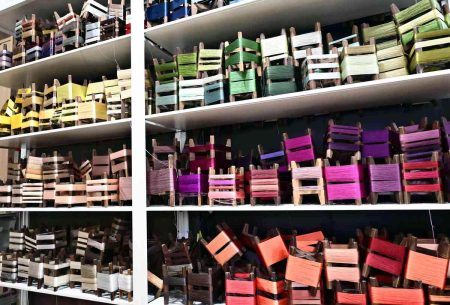
The Yomiuri Shimbun
Colorful threads wound around a wooden braiding stand -

The Yomiuri Shimbun
Colorful threads wound around a wooden braiding stand


He learned the basics from his mother and other artisans and honed his skills by making work to be shown and sold at department stores and participating in traditional craft exhibitions.
Although the retirement of many elderly artisans from Nakamurasho made it impossible for the company to make its kumihimo products in large quantities, a specialty kimono shop began directly ordering items from them. At one solo exhibition, Nakamura was able to sell about 30 products in a week.
He sometimes gives lectures on kumihimo to people who have enough interest in the products to visit his workshop. “There are still many people who want hand-braided kumihimo products. To preserve the culture of traditional Japanese attire, I also want to continue my efforts to increase the number of people who work with these goods,” he said.
Braiding stands
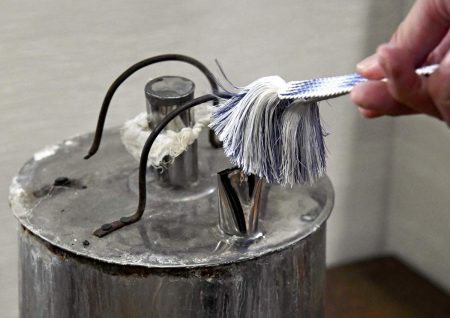
The ends of obijime cords are straightened with steam.
Kumihimo’s beautiful patterns are created with the use of different braiding stands. One of them is the marudai, which has a hole in the center, allowing the creation of various patterns such as spirals and rectangles.
By attaching weights ranging from 60 to 750 grams each below the hole and adjusting the tension on the threads, the user can control how stiff or flexible the cord is.
Complex patterns such as ones resembling hailstones or flowing water are created using the semi-automatic naikidai braiding tool. The tool’s rotating gears allow multiple threads to be woven through it simultaneously.
In recent years, Nakamura has sometimes received braiding tools from artisans who have retired due to age. He learns how to use these tools as he repairs them, thereby enhancing his skills as artisan.


Related Tags





Most Read
Most read in the last 24 hours
-

Stepfather Reportedly Admits to Killing 11-Year-Old Boy Who Went ...
-

Trump Urges Extending Foreign Surveillance Program as Some Lawmak...
-

Iran Offers Proposal Allowing Ships to Exit Oman Side of Hormuz F...
-

S&P 500, Nasdaq Push to Closing Records on Optimism around Middle...
-

Pakistani Delegation Meets in Tehran Hoping for More US-Iran Talk...
-

Japan, US Agree to Intensify Communication on Exchange Rates
-

China's Xi Calls for Strategic Clarity, Political Security with V...
-

Sexual Abuse Allegations Are Spurring Calls for a Broader Reckoni...
Most read in the last 7 days
-

Police Find Child's Shoe During Search for Missing Boy in Nantan,...
-

Body Found in Nantan, Kyoto Prefecture, During Search for 11-Year...
-

Japanese Prime Minister Takaichi Speaks to Pakistani Prime Minist...
-

Kyoto Police Arrests Father of 11-Year-Old Boy on Suspicion of Ab...
-

Body Found in Kyoto Pref. Forest Confirmed to Be Missing 11-Year-...
-
Strong Typhoon Sinlaku Heading Toward Tokyo's Ogasawara Islands
-

No Clear Plan for Expo Site 6 Months After Close; Delays, Unpaid ...
-
Kyoto Boy Missing for 20 Days; Largescale Search Continues in Nan...
Most read in the last 30 days
-

Mathematician Heisuke Hironaka, Winner of Fields Medal, Dies at 9...
-
Police Find Child's Shoe During Search for Missing Boy in Nantan,...
-
Body Found in Nantan, Kyoto Prefecture, During Search for 11-Year...
-

Cherry Blossoms, Rapeseed Flowers Perform Colorful ‘Duet’ in Niig...
-
New Bird Species Confirmed in Japan for 1st Time in 45 Years, Fou...
-

Nori Prices Surge in Japan Due to Poor Seaweed Production Amid Ri...
-

Earthquake Jolts Kansai Region, Recording Magnitude 4.2, Japanese...
-

Cherry Blossoms in Full Bloom Draw Crowds in Sendai, Miyagi Pref....
Top Articles in Culture
-

Kyoto Native Indigo Dyeing Artisan Wins Top Prize at Traditional Craft Contest for Work Made Using Local Resources
-

Japanese Anime ‘Precure’ Takes on Detective Genre in 23rd Series, Solving Mysterious Cases
-

‘Ichi the Witch’ Manga Writer, Illustrator Talk About Working Together, Creating World of 1st ‘Male Witch’
-
Kabuki Actor Nakamura Takanosuke Looking Forward to Seeing Audiences’ Reactions in Europe in His First Overseas Performances
-
Potter in Japan Concerned That Iran War Is Destroying Persian Culture
JN ACCESS RANKING
-
Police Find Child’s Shoe During Search for Missing Boy in Nantan, Kyoto Prefecture
-
Body Found in Nantan, Kyoto Prefecture, During Search for 11-Year-Old Boy in Area (Update 1)
-
Cherry Blossoms, Rapeseed Flowers Perform Colorful ‘Duet’ in Niigata
-
New Bird Species Confirmed in Japan for 1st Time in 45 Years, Found on Tokara Islands in Kagoshima Pref.
-
Nori Prices Surge in Japan Due to Poor Seaweed Production Amid Rising Sea Temps; Price of Onigiri Rice Balls Also Impacted
Most read in the last 24 hours
-
Stepfather Reportedly Admits to Killing 11-Year-Old Boy Who Went ...
-
Trump Urges Extending Foreign Surveillance Program as Some Lawmak...
-
Iran Offers Proposal Allowing Ships to Exit Oman Side of Hormuz F...
-
S&P 500, Nasdaq Push to Closing Records on Optimism around Middle...
-
Pakistani Delegation Meets in Tehran Hoping for More US-Iran Talk...
Most read in the last 7 days
-
Police Find Child's Shoe During Search for Missing Boy in Nantan,...
-
Body Found in Nantan, Kyoto Prefecture, During Search for 11-Year...
-
Japanese Prime Minister Takaichi Speaks to Pakistani Prime Minist...
-
Kyoto Police Arrests Father of 11-Year-Old Boy on Suspicion of Ab...
-
Body Found in Kyoto Pref. Forest Confirmed to Be Missing 11-Year-...
Most read in the last 30 days
-
Mathematician Heisuke Hironaka, Winner of Fields Medal, Dies at 9...
-
Police Find Child's Shoe During Search for Missing Boy in Nantan,...
-
Body Found in Nantan, Kyoto Prefecture, During Search for 11-Year...
-
Cherry Blossoms, Rapeseed Flowers Perform Colorful ‘Duet’ in Niig...
-
New Bird Species Confirmed in Japan for 1st Time in 45 Years, Fou...