

17:26 JST, December 8, 2020
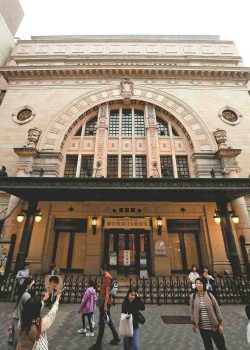
A special program titled “Buddha and Enma” was held at the National Noh Theatre in Tokyo’s Sendagaya area on Nov. 28 and 29.
Enma is the king of Buddhist hell. He is also the judge of the afterlife who decides whether the dead proceed to paradise (distinct from “heaven”) or to hell based on how they have lived their lives. Since ancient times, it has been said in Japan, “If you lie, Enma will pull out your tongue.” Enma is an object of fear for the Japanese.
The National Noh Theatre is dedicated to noh and kyogen. Its latest program included works connected to Buddha and Enma, such as the noh play “Daie” (The Great Sermon) and the kyogen play “Asahina” (Asahina the Warrior). There were also works from other fields, such as kodan and rakugo storytelling, the recitation of short stories by a contemporary drama actor and a shamisen performance called shinnai. It was a unique program highlighting the religious views that underlie all traditional Japanese performing arts.
Ponytailed kodan storyteller Takarai Kincho headlined the program, narrating “Shibarare Jizo” (The Rope-Bound Jizo Statue), one of the stories about Ooka Echizen no Kami, a famous magistrate of the Edo period (1603-1868).
Jizo is a bosatsu (bodhisattva), a being on the path toward becoming a Buddha who saves ordinary people. Statues of Jizo are often seen standing on roadsides across Japan.
In “Shibarare Jizo,” a merchant makes up his mind to commit suicide after his valuables are stolen, and Magistrate Ooka tries to save him. Ooka issues a startling order that a Jizo statue standing at the crime scene be tied up with a rope for “assisting” the culprit. In fact, this is part of a stratagem by Ooka to find the real culprit. With Kincho’s friendly tone, the audience, including myself, was naturally lured into the world of the Edo period.
Kincho was followed by rakugo storyteller Katsura Yonedanji, an exemplar of the Kamigata style that was developed in the Kansai region, who lured us into the underworld in “Jigoku Bakkei Moja no Tawamure” (A Dead Man’s Journey to Hell). It was a signature work for Yonedanji’s father, Katsura Beicho, a living national treasure who passed away five years ago. Yonedanji has taken over his father’s work.
The story amusingly depicts the afterlife journeys of various people waiting to be judged by Enma. The story’s appeal is that storytellers can insert a variety of improvisations. Yonedanji got a great laugh from the audience by deftly adding kabuki actor Sakata Tojuro, who had died just weeks earlier, to the story as a newcomer at a kabuki theater of the beyond, as well as recently deceased soccer great Diego Maradona, who dribbles toward paradise past five opponents — Enma and his ogre guards.
On top of them, actor Takaaki Enoki read Akutagawa Ryunosuke’s “Kumo no Ito” (The Spider’s Thread), a short story about a villain in hell, and Shinnai Tagatayu dialogically sang “Asahina Jigokumeguri” (Lord Asahina Travels Through Hell) with his father, living national treasure Shinnai Nakasaburo, singing and playing shamisen. The story is about Lord Asahina Saburo, who fights against the ogres of hell.
Noh, the oldest of the Japanese performing arts in this program, has many stories depicting ghosts and the afterworld. After watching all those plays, I realized that other performing arts that appeared after noh seemed to follow noh’s style of “visualizing the unseen.”
— Morishige covers traditional performing arts.







Most Read
Most read in the last 24 hours
-

Stepfather Reportedly Admits to Killing 11-Year-Old Boy Who Went ...
-

Trump Urges Extending Foreign Surveillance Program as Some Lawmak...
-

Iran Offers Proposal Allowing Ships to Exit Oman Side of Hormuz F...
-

S&P 500, Nasdaq Push to Closing Records on Optimism around Middle...
-

Pakistani Delegation Meets in Tehran Hoping for More US-Iran Talk...
-

Japan, US Agree to Intensify Communication on Exchange Rates
-

China's Xi Calls for Strategic Clarity, Political Security with V...
-

Sexual Abuse Allegations Are Spurring Calls for a Broader Reckoni...
Most read in the last 7 days
-
Police Find Child's Shoe During Search for Missing Boy in Nantan,...
-

Body Found in Nantan, Kyoto Prefecture, During Search for 11-Year...
-

Japanese Prime Minister Takaichi Speaks to Pakistani Prime Minist...
-

Kyoto Police Arrests Father of 11-Year-Old Boy on Suspicion of Ab...
-

Body Found in Kyoto Pref. Forest Confirmed to Be Missing 11-Year-...
-
Strong Typhoon Sinlaku Heading Toward Tokyo's Ogasawara Islands
-

No Clear Plan for Expo Site 6 Months After Close; Delays, Unpaid ...
-
Kyoto Boy Missing for 20 Days; Largescale Search Continues in Nan...
Most read in the last 30 days
-

Mathematician Heisuke Hironaka, Winner of Fields Medal, Dies at 9...
-
Police Find Child's Shoe During Search for Missing Boy in Nantan,...
-
Body Found in Nantan, Kyoto Prefecture, During Search for 11-Year...
-

Cherry Blossoms, Rapeseed Flowers Perform Colorful ‘Duet’ in Niig...
-

New Bird Species Confirmed in Japan for 1st Time in 45 Years, Fou...
-

Nori Prices Surge in Japan Due to Poor Seaweed Production Amid Ri...
-

Earthquake Jolts Kansai Region, Recording Magnitude 4.2, Japanese...
-

Cherry Blossoms in Full Bloom Draw Crowds in Sendai, Miyagi Pref....
Top Articles in Culture
-

Kyoto Native Indigo Dyeing Artisan Wins Top Prize at Traditional Craft Contest for Work Made Using Local Resources
-

Japanese Anime ‘Precure’ Takes on Detective Genre in 23rd Series, Solving Mysterious Cases
-

‘Ichi the Witch’ Manga Writer, Illustrator Talk About Working Together, Creating World of 1st ‘Male Witch’
-

Kabuki Actor Nakamura Takanosuke Looking Forward to Seeing Audiences’ Reactions in Europe in His First Overseas Performances
-

Potter in Japan Concerned That Iran War Is Destroying Persian Culture
JN ACCESS RANKING
-
Police Find Child’s Shoe During Search for Missing Boy in Nantan, Kyoto Prefecture
-
Body Found in Nantan, Kyoto Prefecture, During Search for 11-Year-Old Boy in Area (Update 1)
-
Cherry Blossoms, Rapeseed Flowers Perform Colorful ‘Duet’ in Niigata
-
New Bird Species Confirmed in Japan for 1st Time in 45 Years, Found on Tokara Islands in Kagoshima Pref.
-
Nori Prices Surge in Japan Due to Poor Seaweed Production Amid Rising Sea Temps; Price of Onigiri Rice Balls Also Impacted
Most read in the last 24 hours
-
Stepfather Reportedly Admits to Killing 11-Year-Old Boy Who Went ...
-
Trump Urges Extending Foreign Surveillance Program as Some Lawmak...
-
Iran Offers Proposal Allowing Ships to Exit Oman Side of Hormuz F...
-
S&P 500, Nasdaq Push to Closing Records on Optimism around Middle...
-
Pakistani Delegation Meets in Tehran Hoping for More US-Iran Talk...
Most read in the last 7 days
-
Police Find Child's Shoe During Search for Missing Boy in Nantan,...
-
Body Found in Nantan, Kyoto Prefecture, During Search for 11-Year...
-
Japanese Prime Minister Takaichi Speaks to Pakistani Prime Minist...
-
Kyoto Police Arrests Father of 11-Year-Old Boy on Suspicion of Ab...
-
Body Found in Kyoto Pref. Forest Confirmed to Be Missing 11-Year-...
Most read in the last 30 days
-
Mathematician Heisuke Hironaka, Winner of Fields Medal, Dies at 9...
-
Police Find Child's Shoe During Search for Missing Boy in Nantan,...
-
Body Found in Nantan, Kyoto Prefecture, During Search for 11-Year...
-
Cherry Blossoms, Rapeseed Flowers Perform Colorful ‘Duet’ in Niig...
-
New Bird Species Confirmed in Japan for 1st Time in 45 Years, Fou...