
‘Dark Patterns’ Exploit Online Consumers’ Vulnerabilities; Psychological Manipulation Can Spur Unwanted Purchases
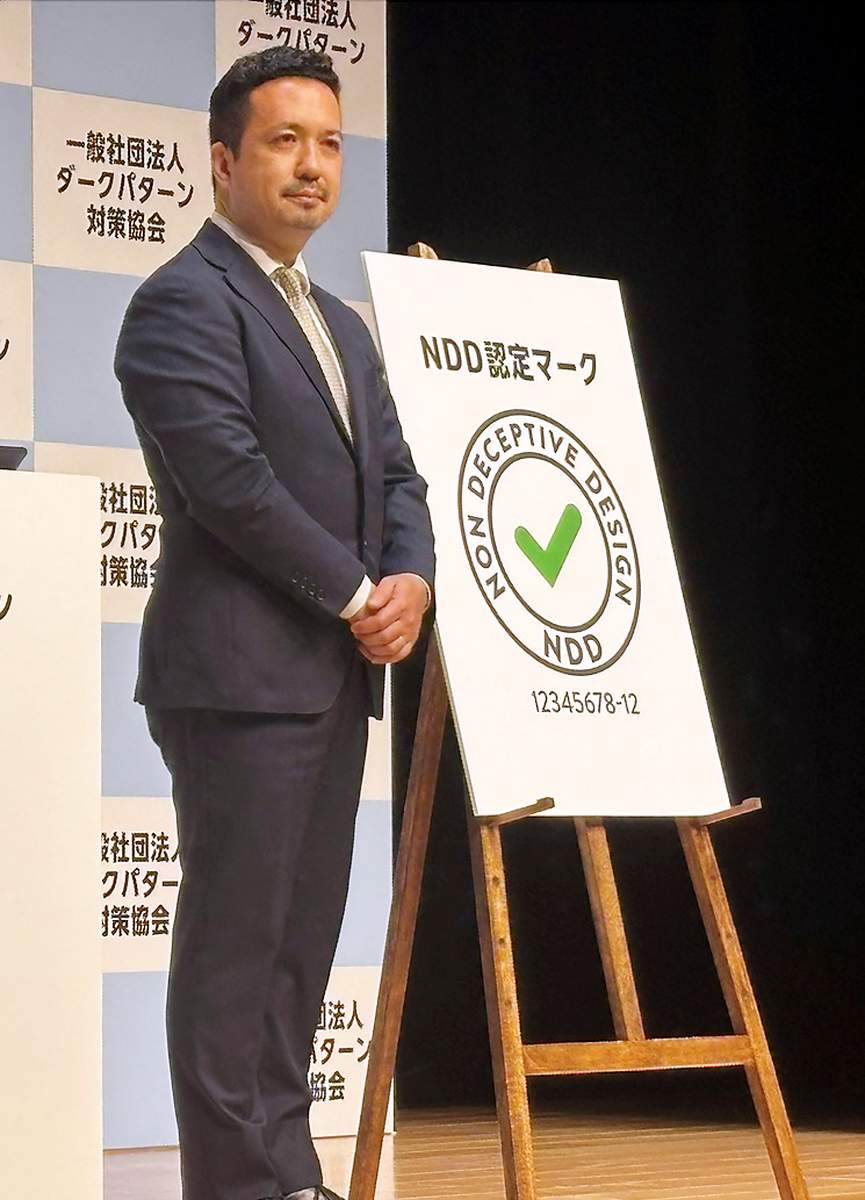
Antonios Karaiskos introduces a “NonDeceptive Design” accreditation mark at a press conference in Tokyo on July 15.
8:00 JST, August 2, 2025
Concerns are growing over “dark patterns” that manipulate consumers into making unintended choices on their computers and smartphones, prodding them to make purchases or sign contracts.
Examples of dark patterns include displaying countdown timers to pressure consumers into making decisions within a limited time frame or using vague and misleading phrases such as “low in stock” to stimulate purchasing desire. While some practices are legally regulated, many fall into a gray area. To avoid being deceived by tricky marketing tactics in the digital space, it is important for us to recognize that we may not always make decisions based on rational judgment.
The term “dark patterns” was coined in 2010. Harry Brignull, a British expert in web design and related fields, defined a dark pattern as “a user interface that has been carefully crafted to trick users into doing things, such as buying insurance with their purchase or signing up for recurring bills.” He urged consumers to be cautious.
Since then, researchers and government agencies have analyzed various types of dark patterns and the biases they exploit to influence behavior.
The Organization for Economic Cooperation and Development has categorized dark patterns into seven types. These include “obstruction,” which complicates the cancellation process as a way to prolong contracts, and “forced action,” which tricks or forces consumers into sharing more information than they wish. Another example is “interface interference,” in which the options desired by the seller are prominent or preselected by default.
Dark patterns are effective because they exploit biases or weaknesses in human psychology. Here are some examples.
First, there is the bias known as social proof. This bias causes people to follow the opinions that are popular around them. In today’s information-saturated society, it is difficult to carefully evaluate each piece of information and make judgments on one’s own, so it is reasonable to refer to the opinions of others. It amounts to saying, “Everyone else says it’s good.”
When it comes to shopping, we don’t want to spend time and effort researching products every time. That is why we care about reputation. However, if that reputation is intentionally fabricated, the situation is different. Examples include claiming to be the best in quality without sufficient supporting research or posting reviews that may be false.
There is also a bias that makes us perceive hard-to-obtain items as valuable. This is known as the scarcity effect. For example, popular items can become even more attention-grabbing and more difficult to obtain because they are scarce. The combination of “popularity” as social proof and “scarcity” creates long lines to buy. When we see the same item available in abundance later on, we might realize that not only the quality of the product but also the power of the “scarcity” appeal influenced our decision to buy.
The psychological mechanisms behind the effectiveness of dark patterns, such as the phrase “low in stock,” likely stem from these mental processes. Similarly, the term “limited time only” appeals to the idea of a rare product available only now, triggering an emotional response.
Such dark patterns are sometimes regulated by consumer protection laws, but there remain gray areas in which it is unclear whether they are legal or illegal.
The Association for Countermeasures Against Dark Patterns, established in September 2024 by concerned companies and experts, plans to certify honest websites that do not use dark patterns with the designation “Non-Deceptive Design” after evaluating the websites. The association will award them an accreditation mark to ensure that consumers can shop safely on secure sites. Antonios Karaiskos, a director of the association and a professor at Ryukoku University, announced the accreditation mark at a press conference in Tokyo on July 15.
Dark patterns encourage consumption by leveraging evolving digital technology to exploit human biases. In the future, artificial intelligence may analyze individual consumers’ bias tendencies — such as whether they are prone to feeling rushed by time constraints like countdown timers — and create dark patterns targeting each person’s vulnerabilities.
Considering this as a drawback of AI development, it becomes apparent that dark patterns share similarities with the serious issue of online misinformation. Uncertain rumors and misinformation have existed in society for a long time, but AI that can mass-produce sophisticated misinformation is exacerbating the situation. When it comes to shopping, there have always been exaggerated and misleading sales pitches, but the expansion of digital transactions is raising new concerns.
While the digital space offers the convenience of being able to shop almost anytime, it is important to be conscious of the new risks that arise in this environment, which lacks the simplicity of the traditional shopping experience of handling products and conversing with human beings on the store staff.
Political Pulse appears every Saturday.

Makoto Mitsui
Makoto Mitsui is a Senior Research Fellow at Yomiuri Research Institute.








Most Read
Most read in the last 24 hours
-

Kyoto Police Arrests Father of 11-Year-Old Boy on Suspicion of Ab...
-

Stepfather Reportedly Admits to Killing 11-Year-Old Boy Who Went ...
-

Trump Urges Extending Foreign Surveillance Program as Some Lawmak...
-

Govt to Tighten Controls over Weapons after Export with New Rules...
-

Iran Offers Proposal Allowing Ships to Exit Oman Side of Hormuz F...
-

Father of 11-Year-Old Kyoto Boy Implies Abandoning Boy's Body dur...
-

Pakistani Delegation Meets in Tehran Hoping for More US-Iran Talk...
-

S&P 500, Nasdaq Push to Closing Records on Optimism around Middle...
Most read in the last 7 days
-

Police Find Child's Shoe During Search for Missing Boy in Nantan,...
-

Body Found in Nantan, Kyoto Prefecture, During Search for 11-Year...
-

Japanese Prime Minister Takaichi Speaks to Pakistani Prime Minist...
-

Body Found in Kyoto Pref. Forest Confirmed to Be Missing 11-Year-...
-
Kyoto Police Arrests Father of 11-Year-Old Boy on Suspicion of Ab...
-
Strong Typhoon Sinlaku Heading Toward Tokyo's Ogasawara Islands
-

No Clear Plan for Expo Site 6 Months After Close; Delays, Unpaid ...
-
Kyoto Boy Missing for 20 Days; Largescale Search Continues in Nan...
Most read in the last 30 days
-

Mathematician Heisuke Hironaka, Winner of Fields Medal, Dies at 9...
-
Police Find Child's Shoe During Search for Missing Boy in Nantan,...
-
Body Found in Nantan, Kyoto Prefecture, During Search for 11-Year...
-

Cherry Blossoms, Rapeseed Flowers Perform Colorful ‘Duet’ in Niig...
-

New Bird Species Confirmed in Japan for 1st Time in 45 Years, Fou...
-

Nori Prices Surge in Japan Due to Poor Seaweed Production Amid Ri...
-

Earthquake Jolts Kansai Region, Recording Magnitude 4.2, Japanese...
-

Cherry Blossoms in Full Bloom Draw Crowds in Sendai, Miyagi Pref....
Top Articles in Editorial & Columns
-

Ceasefire in Iran: Make This a Step toward Completely Ending Strikes
-
U.S.-Iran Talks: Exhaust All Diplomatic Efforts To Ensure Ceasefire Does Not Collapse
-

Can Japan Maintain Role as Bridge Between U.S. and Iran? Takaichi’s Diplomacy to Be Tested
-
2nd Half of Diet Session: Take Urgent Measures to Overcome Crisis in Middle East
-
Emergency Shelters: What Should Be Done to Increase Designated Underground Facilities?
JN ACCESS RANKING
-
Police Find Child’s Shoe During Search for Missing Boy in Nantan, Kyoto Prefecture
-
Body Found in Nantan, Kyoto Prefecture, During Search for 11-Year-Old Boy in Area (Update 1)
-
Cherry Blossoms, Rapeseed Flowers Perform Colorful ‘Duet’ in Niigata
-
New Bird Species Confirmed in Japan for 1st Time in 45 Years, Found on Tokara Islands in Kagoshima Pref.
-
Nori Prices Surge in Japan Due to Poor Seaweed Production Amid Rising Sea Temps; Price of Onigiri Rice Balls Also Impacted
Most read in the last 24 hours
-
Kyoto Police Arrests Father of 11-Year-Old Boy on Suspicion of Ab...
-
Stepfather Reportedly Admits to Killing 11-Year-Old Boy Who Went ...
-
Trump Urges Extending Foreign Surveillance Program as Some Lawmak...
-
Govt to Tighten Controls over Weapons after Export with New Rules...
-
Iran Offers Proposal Allowing Ships to Exit Oman Side of Hormuz F...
Most read in the last 7 days
-
Police Find Child's Shoe During Search for Missing Boy in Nantan,...
-
Body Found in Nantan, Kyoto Prefecture, During Search for 11-Year...
-
Japanese Prime Minister Takaichi Speaks to Pakistani Prime Minist...
-
Body Found in Kyoto Pref. Forest Confirmed to Be Missing 11-Year-...
-
Kyoto Police Arrests Father of 11-Year-Old Boy on Suspicion of Ab...
Most read in the last 30 days
-
Mathematician Heisuke Hironaka, Winner of Fields Medal, Dies at 9...
-
Police Find Child's Shoe During Search for Missing Boy in Nantan,...
-
Body Found in Nantan, Kyoto Prefecture, During Search for 11-Year...
-
Cherry Blossoms, Rapeseed Flowers Perform Colorful ‘Duet’ in Niig...
-
New Bird Species Confirmed in Japan for 1st Time in 45 Years, Fou...