
19:57 JST, June 23, 2025
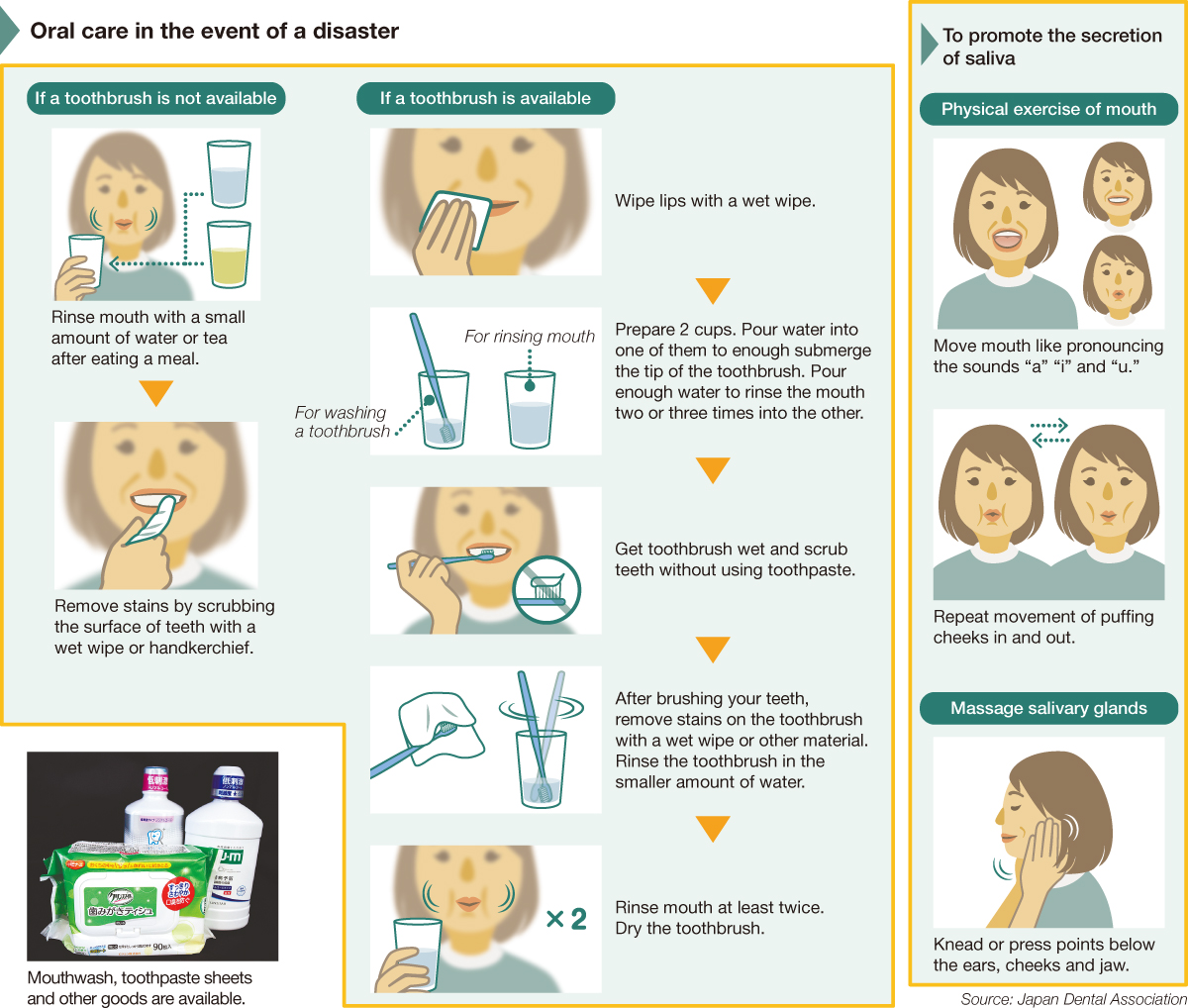
People tend to be reluctant to brush their teeth when it is difficult to obtain a sufficient amount of water in the event of a disaster.
In a prolonged disaster situation, germs could increase inside the mouth if oral care is not performed regularly, possibly resulting in life-threatening diseases.
It is good to know some key points of oral care that can be done without much water.
Risk of aspiration pneumonia
“Although people believe they will not die even if they do not brush their teeth, germs inside the mouth could cause an illness that may be life-threatening to an elderly person,” said Koichi Nakakuki, a lecturer at the graduate school of Tohoku University who has conducted relief activities in disaster-hit areas as a dentist.
If people fail to brush their teeth or wash artificial teeth because tap water is not available or there is some other inconvenience, germs reproduce and increase inside the mouth.
Failing to perform such oral care raises the risk of developing aspiration pneumonia, which is caused by germs in the mouth entering the lungs, and blood poisoning, which is caused by germs getting into the body through wounds in the mouth.
Such risks that arise during a disaster have gained attention as studies on the relationship between aspiration pneumonia and oral care have progressed since the latter half of the 1990s following the 1995 Great Hanshin Earthquake.
Nakakuki went to areas devastated by the Noto Peninsula Earthquake in January last year and noticed that there were few places with private spaces where evacuees could brush their teeth without worrying about other people watching.
“In evacuation shelters in school gyms and other public facilities, in many cases, there were no restrooms with separate spaces,” Nakakuki said. “I want people not to forget about keeping the inside of their mouth clean even in such situations.”
Promoting secretion of saliva
Keisuke Nomura, a standing director of the Japan Dental Association in charge of disaster relief, emphasized the importance of oral care before going to bed and after waking up in the morning.
People should know that the amount of saliva decreases during sleep and the number of germs inside the mouth increases.
If water is available only from a small plastic bottle, it is recommended to get a toothbrush wet with a little bit of water and brush one’s teeth without using toothpaste.
The key point is rinsing the mouth properly.
“Rather than rinsing the mouth once with a lot of water, doing so twice with small amounts of water can effectively remove stains in the mouth,” Nomura said.
Stains on a toothbrush can be removed with wet wipes. If enough water is available, using toothpaste is OK. After using a toothbrush, it should be dried sufficiently.
If a toothbrush is not available, rinsing the mouth with only water or tea can be effective, Nomura said. Having mouthwash or toothpaste sheets prepared in advance is recommended.
People with artificial teeth need to clean them properly. If people forget to bring agents to wash artificial teeth when they evacuate, scrubbing artificial teeth with a neutral detergent like dish soap is OK.
“Although some people may conceal the fact that they have artificial teeth, I hope they will wash them at least once a day while making efforts such as concealing their mouth with a mask,” Nomura said.
In the event of a disaster, saliva flows less because of stress.
Because saliva has the function of keeping the inside of the mouth clean, it is recommended to promote the secretion of saliva by massaging the mouth or moving it.
“Simply chatting with others and laughing move the muscles of the mouth, which makes saliva flow more,” Nomura said. “I want people to be conscious about moving their mouth.”





Most Read
Most read in the last 24 hours
-

Stepfather Reportedly Admits to Killing 11-Year-Old Boy Who Went ...
-

Trump Urges Extending Foreign Surveillance Program as Some Lawmak...
-

Iran Offers Proposal Allowing Ships to Exit Oman Side of Hormuz F...
-

S&P 500, Nasdaq Push to Closing Records on Optimism around Middle...
-

Pakistani Delegation Meets in Tehran Hoping for More US-Iran Talk...
-

Japan, US Agree to Intensify Communication on Exchange Rates
-

China's Xi Calls for Strategic Clarity, Political Security with V...
-

Sexual Abuse Allegations Are Spurring Calls for a Broader Reckoni...
Most read in the last 7 days
-
Police Find Child's Shoe During Search for Missing Boy in Nantan,...
-
Body Found in Nantan, Kyoto Prefecture, During Search for 11-Year...
-

Japanese Prime Minister Takaichi Speaks to Pakistani Prime Minist...
-

Kyoto Police Arrests Father of 11-Year-Old Boy on Suspicion of Ab...
-

Body Found in Kyoto Pref. Forest Confirmed to Be Missing 11-Year-...
-
Strong Typhoon Sinlaku Heading Toward Tokyo's Ogasawara Islands
-

No Clear Plan for Expo Site 6 Months After Close; Delays, Unpaid ...
-
Kyoto Boy Missing for 20 Days; Largescale Search Continues in Nan...
Most read in the last 30 days
-
Mathematician Heisuke Hironaka, Winner of Fields Medal, Dies at 9...
-
Police Find Child's Shoe During Search for Missing Boy in Nantan,...
-
Body Found in Nantan, Kyoto Prefecture, During Search for 11-Year...
-

Cherry Blossoms, Rapeseed Flowers Perform Colorful ‘Duet’ in Niig...
-
New Bird Species Confirmed in Japan for 1st Time in 45 Years, Fou...
-
Nori Prices Surge in Japan Due to Poor Seaweed Production Amid Ri...
-

Earthquake Jolts Kansai Region, Recording Magnitude 4.2, Japanese...
-

Cherry Blossoms in Full Bloom Draw Crowds in Sendai, Miyagi Pref....
Top Articles in JN Specialities
-
Tokyo Wards Train Volunteer Tour Guides for Locals Passionate About Their Area’s Charms
-

Tateyama Soup Curry in Chiba Challenges Its Sapporo Roots, Cafe Owner Looks to Local Area for Best Ingredients
-
Winter Camping Provides Unique, Fun Experience
-
Personal History Helps You Look Back, Move Forward; Editor Gives Advice to Those Writing Their Story
-

Walking in Endless Snow-Covered Fields in Nagano Pref.’s Utsukushigahara
JN ACCESS RANKING
-
Police Find Child’s Shoe During Search for Missing Boy in Nantan, Kyoto Prefecture
-
Body Found in Nantan, Kyoto Prefecture, During Search for 11-Year-Old Boy in Area (Update 1)
-
Cherry Blossoms, Rapeseed Flowers Perform Colorful ‘Duet’ in Niigata
-
New Bird Species Confirmed in Japan for 1st Time in 45 Years, Found on Tokara Islands in Kagoshima Pref.
-
Nori Prices Surge in Japan Due to Poor Seaweed Production Amid Rising Sea Temps; Price of Onigiri Rice Balls Also Impacted
Most read in the last 24 hours
-
Stepfather Reportedly Admits to Killing 11-Year-Old Boy Who Went ...
-
Trump Urges Extending Foreign Surveillance Program as Some Lawmak...
-
Iran Offers Proposal Allowing Ships to Exit Oman Side of Hormuz F...
-
S&P 500, Nasdaq Push to Closing Records on Optimism around Middle...
-
Pakistani Delegation Meets in Tehran Hoping for More US-Iran Talk...
Most read in the last 7 days
-
Police Find Child's Shoe During Search for Missing Boy in Nantan,...
-
Body Found in Nantan, Kyoto Prefecture, During Search for 11-Year...
-
Japanese Prime Minister Takaichi Speaks to Pakistani Prime Minist...
-
Kyoto Police Arrests Father of 11-Year-Old Boy on Suspicion of Ab...
-
Body Found in Kyoto Pref. Forest Confirmed to Be Missing 11-Year-...
Most read in the last 30 days
-
Mathematician Heisuke Hironaka, Winner of Fields Medal, Dies at 9...
-
Police Find Child's Shoe During Search for Missing Boy in Nantan,...
-
Body Found in Nantan, Kyoto Prefecture, During Search for 11-Year...
-
Cherry Blossoms, Rapeseed Flowers Perform Colorful ‘Duet’ in Niig...
-
New Bird Species Confirmed in Japan for 1st Time in 45 Years, Fou...