
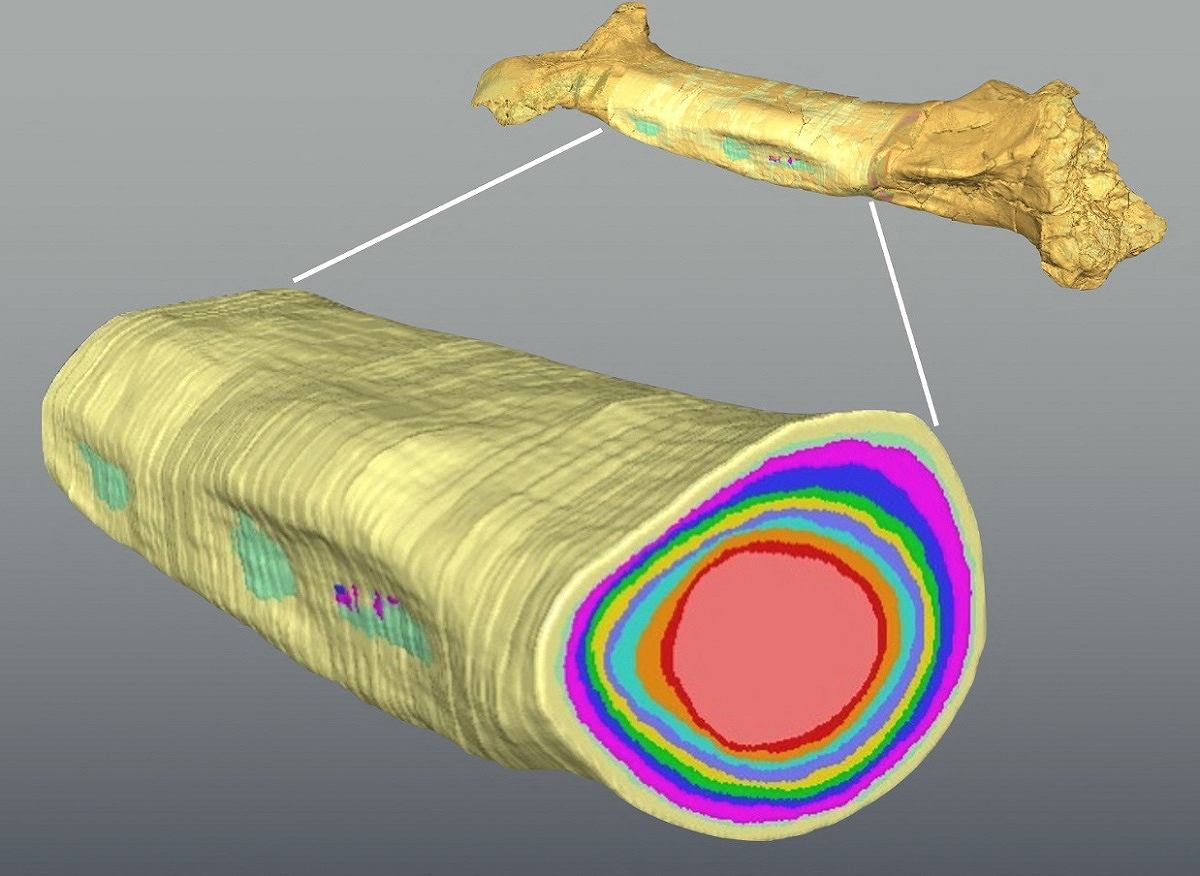
A 3D model generated from a CT scan of the shin bone of the Majungasaurus crenatissimus is seen in this undated handout image.
15:34 JST, March 23, 2023
WASHINGTON (Reuters) — The dinosaur group called theropods included the largest land meat-eaters ever on Earth — up to the size of a school bus. But there also were theropods the size of a tabby cat and others of various dimensions, including beaked and toothless fruit eaters and some bizarre long-clawed species that redefine weird.
Scientists had long believed that these dinosaurs followed a uniform pattern in determining the body size of a species, whether gigantic or diminutive, with the rate of growth being the deciding factor — faster meaning bigger and slower meaning smaller. A new study added to the evidence overturning that idea.
Researchers said last month they examined rings called cortical growth marks laid down annually inside the bones as these animals grew — akin to growth rings inside tree trunks — of three dozen theropod species. Widely spaced rings indicate a speedier growth rate. Closely spaced rings indicate slower growth.
They found no common pattern underpinning body size. Some huge theropods grew quickly and stopped growing and some grew gradually over a longer period of time to reach the same size. Some small theropods grew rapidly and others slowly.
“Our paper overturns an axiom about dinosaur growth, suggesting that other groups should be studied systematically as well to see if our conclusions apply to other animals,” said paleontologist Mike D’Emic of Adelphi University in New York, lead author of the study published in the journal Science.
“It’s equally likely that an animal evolved larger body size by growing at the same rate for longer, rather than just growing faster. It is surprising and important to know that animals are just as likely to evolve to gigantic sizes at slow rates. That means they are smaller for longer — and are thus susceptible to predators for longer — and have longer lifespans,” D’Emic added.
Tyrannosaurus, topping 12 meters long, was an example of a big and fast-growing theropod, with a large growth spurt in its teenage years — in some years quadrupling its body mass. Acrocanthosaurus, a bit smaller than T. rex, was an example of a big but slow-growing theropod.
Coelophysis, about 2 meters long, was a fast-growing smaller theropod. Xixianykus, one of the tiniest dinosaurs at 50 centimeters long, was a small and slow-growing theropod.
Spinosaurus, an immense semiaquatic theropod up to 15 meters long, grew much more slowly than Tyrannosaurus. Mapusaurus, which reached about 11.5 meters, grew even more quickly than Tyrannosaurus, while its similar size cousin Tyrannotitan had a growth rate like that of Spinosaurus.
“This is the first study to consider developmental mechanisms related to bone growth and body size variation in a large sample of predatory dinosaurs,” said Ohio University evolutionary biologist and study coauthor Patrick O’Connor.
“Although focused on theropod dinosaurs, the implications of this work should extend to most groups of land-living animals, allowing scientists to better constrain the interplay among genetics, development and environmental factors that ultimately give rise to the diversity of life around us,” O’Connor added.
Theropods are known for their bipedal stance and a set of shared anatomical traits. The earliest theropods may have lived as long as 230 million years ago during the Triassic Period in South America. The group spread worldwide and lasted to the end of the age of dinosaurs when an asteroid strike triggered a mass extinction 66 million years ago during the Cretaceous period.
Birds evolved from small feathered theropods during the Jurassic period and are considered part of the theropod group, though they were not included in this study.
“Large birds grow very quickly, for example an ostrich can grow to a couple hundred pounds in a year or two,” D’Emic said. “Crocodiles and alligators grow very slowly, taking several years to reach that same weight.”


Related Tags





Most Read
Most read in the last 24 hours
-

Kyoto Police Arrests Father of 11-Year-Old Boy on Suspicion of Ab...
-

Stepfather Reportedly Admits to Killing 11-Year-Old Boy Who Went ...
-

Trump Urges Extending Foreign Surveillance Program as Some Lawmak...
-

Govt to Tighten Controls over Weapons after Export with New Rules...
-

Iran Offers Proposal Allowing Ships to Exit Oman Side of Hormuz F...
-

Father of 11-Year-Old Kyoto Boy Implies Abandoning Boy's Body dur...
-

Pakistani Delegation Meets in Tehran Hoping for More US-Iran Talk...
-

S&P 500, Nasdaq Push to Closing Records on Optimism around Middle...
Most read in the last 7 days
-
Police Find Child's Shoe During Search for Missing Boy in Nantan,...
-
Body Found in Nantan, Kyoto Prefecture, During Search for 11-Year...
-

Japanese Prime Minister Takaichi Speaks to Pakistani Prime Minist...
-

Body Found in Kyoto Pref. Forest Confirmed to Be Missing 11-Year-...
-
Kyoto Police Arrests Father of 11-Year-Old Boy on Suspicion of Ab...
-
Strong Typhoon Sinlaku Heading Toward Tokyo's Ogasawara Islands
-

No Clear Plan for Expo Site 6 Months After Close; Delays, Unpaid ...
-
Kyoto Boy Missing for 20 Days; Largescale Search Continues in Nan...
Most read in the last 30 days
-

Mathematician Heisuke Hironaka, Winner of Fields Medal, Dies at 9...
-
Police Find Child's Shoe During Search for Missing Boy in Nantan,...
-
Body Found in Nantan, Kyoto Prefecture, During Search for 11-Year...
-

Cherry Blossoms, Rapeseed Flowers Perform Colorful ‘Duet’ in Niig...
-
New Bird Species Confirmed in Japan for 1st Time in 45 Years, Fou...
-

Nori Prices Surge in Japan Due to Poor Seaweed Production Amid Ri...
-

Earthquake Jolts Kansai Region, Recording Magnitude 4.2, Japanese...
-

Cherry Blossoms in Full Bloom Draw Crowds in Sendai, Miyagi Pref....
Top Articles in Science & Nature
-

Govt Aims to Establish Bear Population Control by FY30, Hopes to Achieve ‘Coexistence’ with Bears
-
Punch The Monkey Getting Used to Life Without Stuffed ‘Mother’
-

‘Electric Aircraft’ to Begin Test Flights from Kitakyushu Airport, Aiming for Practical Use in Cargo Transport Route
-

Tokyo Govt to Encourage Offshore Wind Power by Surveying Seabed near Izu Islands
-

2025 Osaka-Kansai Expo ‘Flying Car’ Opens Simulation Theater in Osaka for Limited Run
JN ACCESS RANKING
-
Police Find Child’s Shoe During Search for Missing Boy in Nantan, Kyoto Prefecture
-
Body Found in Nantan, Kyoto Prefecture, During Search for 11-Year-Old Boy in Area (Update 1)
-
Cherry Blossoms, Rapeseed Flowers Perform Colorful ‘Duet’ in Niigata
-
New Bird Species Confirmed in Japan for 1st Time in 45 Years, Found on Tokara Islands in Kagoshima Pref.
-
Nori Prices Surge in Japan Due to Poor Seaweed Production Amid Rising Sea Temps; Price of Onigiri Rice Balls Also Impacted
Most read in the last 24 hours
-
Kyoto Police Arrests Father of 11-Year-Old Boy on Suspicion of Ab...
-
Stepfather Reportedly Admits to Killing 11-Year-Old Boy Who Went ...
-
Trump Urges Extending Foreign Surveillance Program as Some Lawmak...
-
Govt to Tighten Controls over Weapons after Export with New Rules...
-
Iran Offers Proposal Allowing Ships to Exit Oman Side of Hormuz F...
Most read in the last 7 days
-
Police Find Child's Shoe During Search for Missing Boy in Nantan,...
-
Body Found in Nantan, Kyoto Prefecture, During Search for 11-Year...
-
Japanese Prime Minister Takaichi Speaks to Pakistani Prime Minist...
-
Body Found in Kyoto Pref. Forest Confirmed to Be Missing 11-Year-...
-
Kyoto Police Arrests Father of 11-Year-Old Boy on Suspicion of Ab...
Most read in the last 30 days
-
Mathematician Heisuke Hironaka, Winner of Fields Medal, Dies at 9...
-
Police Find Child's Shoe During Search for Missing Boy in Nantan,...
-
Body Found in Nantan, Kyoto Prefecture, During Search for 11-Year...
-
Cherry Blossoms, Rapeseed Flowers Perform Colorful ‘Duet’ in Niig...
-
New Bird Species Confirmed in Japan for 1st Time in 45 Years, Fou...