
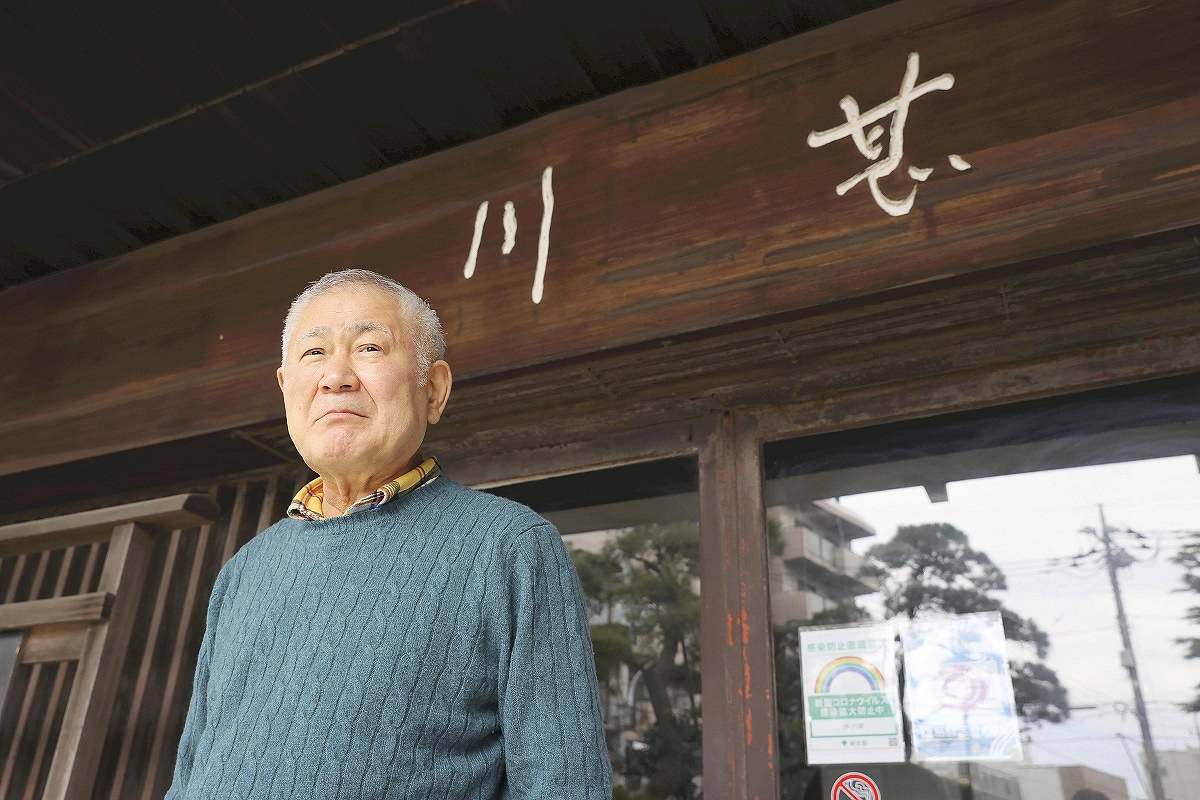
Kazuteru Amamiya stands in front of his restaurant, Kawajin, in Katsushika Ward, Tokyo, on Jan. 27. “I was born and raised in Kawajin. This place has been my life,” he said.
20:28 JST, February 10, 2021
The ever-expanding COVID-19 pandemic has forced many old dining establishments to put an end to their long history. Kawajin, a ryotei restaurant in Shibamata, Tokyo, is one of them. Opened in the latter half of the Edo period (1603-1867), the restaurant had been a beloved culinary institution for over 230 years. The restaurant’s eighth-generation owner made the difficult decision to close at the end of January.
“We had a good run, and [our longevity] was thanks to the customers. All I can say is how grateful I feel,” said the owner, Kazuteru Amamiya, 69, as he looked up at the signboard bearing the ryotei’s name on Jan. 27, four days before the end.
Kawajin opened in 1790 as a boathouse inn serving carp and eels plucked from the Edo river. At first, the inn stood on the banks of the river, and customers could climb up into the dining room directly from their boats until Kawajin relocated further inland in 1918.
The acclaimed view from the inn, overlooking the river and its meandering sailboats, was immortalized in many a novel, including Natsume Soseki’s “To the Spring Equinox and Beyond.” The current building, located near the Shibamata Taishakuten temple, also made a cameo in the first film of the “Otoko wa Tsuraiyo” series, which was released in theatres in 1969. The restaurant provided the setting for the wedding reception of Sakura, sister of the film’s protagonist, Torajiro Kuruma.
An upstream struggle
The ryotei became so popular that, at its height, it was serving over 700 customers a day.
“The best part of our job was seeing the satisfied expressions of customers as they went on their way after the meal,” said Amamiya, who took the reins of the restaurant at the age of 37.
Everything changed under the pandemic. Gone are the steady streams of tourist buses which used to flock to the restaurant. Day after day, the phone rang with customers calling to cancel their dinner reservations. Eventually, the restaurant’s daily sales slipped to less than half what they were the previous year.
Amamiya obtained loans that kept the lights on at the restaurant, but in December last year, he decided to close for good, reasoning that the prospects for recovery were slim, and that he didn’t feel he would be able to face his customers as before, now that his mind was so preoccupied with financial concerns.
On Dec. 20, he lowered his head to the assembled crowd of nearly 20 employees. “You’ve all been working so hard; I’m sorry to have let you down.”
The employees, partners in the fight to save the restaurant, simply listened quietly.
Amamiya also visited the family’s ancestral grave to apologize.
The decision involved considerable soul-searching, and Amamiya admits that he had felt conflicted. “I was the eighth-runner in a long relay, but I’ve dropped out of the race before I had a chance to pass the baton on to the next [generation],” he said. Ultimately, he decided to bow out while there were still funds left in the coffers to provide his employees with severance packages. In that sense, he adds, “I have no regrets.”
Gone but not forgotten
When the impending closure was announced at the end of last year, the restaurant was inundated with visitors and inquiries. Some diners even queued up for three hours to say goodbye with one last meal.
“I have fond memories of this place. I used to dine here with my golf-playing friends. It’s a pity that this local tradition will be lost,” said a 77-year-old man who lives in the neighborhood.
“The architecture was very elegant, very impressive,” recalled actress Chieko Baisho, 79, who played the role of Sakura. “I will miss [Kawajin] very much. I hope the building’s legacy will be preserved in some good way.”

The ryotei restaurant Kawajin is seen in 1905 at its original location on the banks of the Edo river.









Most Read
Most read in the last 24 hours
-

Stepfather Reportedly Admits to Killing 11-Year-Old Boy Who Went ...
-

Trump Urges Extending Foreign Surveillance Program as Some Lawmak...
-

Iran Offers Proposal Allowing Ships to Exit Oman Side of Hormuz F...
-

S&P 500, Nasdaq Push to Closing Records on Optimism around Middle...
-

Pakistani Delegation Meets in Tehran Hoping for More US-Iran Talk...
-

Japan, US Agree to Intensify Communication on Exchange Rates
-

China's Xi Calls for Strategic Clarity, Political Security with V...
-

Sexual Abuse Allegations Are Spurring Calls for a Broader Reckoni...
Most read in the last 7 days
-
Police Find Child's Shoe During Search for Missing Boy in Nantan,...
-
Body Found in Nantan, Kyoto Prefecture, During Search for 11-Year...
-

Japanese Prime Minister Takaichi Speaks to Pakistani Prime Minist...
-

Kyoto Police Arrests Father of 11-Year-Old Boy on Suspicion of Ab...
-

Body Found in Kyoto Pref. Forest Confirmed to Be Missing 11-Year-...
-
Strong Typhoon Sinlaku Heading Toward Tokyo's Ogasawara Islands
-

No Clear Plan for Expo Site 6 Months After Close; Delays, Unpaid ...
-
Kyoto Boy Missing for 20 Days; Largescale Search Continues in Nan...
Most read in the last 30 days
-

Mathematician Heisuke Hironaka, Winner of Fields Medal, Dies at 9...
-
Police Find Child's Shoe During Search for Missing Boy in Nantan,...
-
Body Found in Nantan, Kyoto Prefecture, During Search for 11-Year...
-

Cherry Blossoms, Rapeseed Flowers Perform Colorful ‘Duet’ in Niig...
-

New Bird Species Confirmed in Japan for 1st Time in 45 Years, Fou...
-

Nori Prices Surge in Japan Due to Poor Seaweed Production Amid Ri...
-

Earthquake Jolts Kansai Region, Recording Magnitude 4.2, Japanese...
-

Cherry Blossoms in Full Bloom Draw Crowds in Sendai, Miyagi Pref....
Top Articles in Society
-
Police Find Child’s Shoe During Search for Missing Boy in Nantan, Kyoto Prefecture
-
Body Found in Nantan, Kyoto Prefecture, During Search for 11-Year-Old Boy in Area (Update 1)
-
Cherry Blossoms, Rapeseed Flowers Perform Colorful ‘Duet’ in Niigata
-
New Bird Species Confirmed in Japan for 1st Time in 45 Years, Found on Tokara Islands in Kagoshima Pref.
-
Earthquake Jolts Kansai Region, Recording Magnitude 4.2, Japanese Seismic Intensity Scale 3
JN ACCESS RANKING
-
Police Find Child’s Shoe During Search for Missing Boy in Nantan, Kyoto Prefecture
-
Body Found in Nantan, Kyoto Prefecture, During Search for 11-Year-Old Boy in Area (Update 1)
-
Cherry Blossoms, Rapeseed Flowers Perform Colorful ‘Duet’ in Niigata
-
New Bird Species Confirmed in Japan for 1st Time in 45 Years, Found on Tokara Islands in Kagoshima Pref.
-
Nori Prices Surge in Japan Due to Poor Seaweed Production Amid Rising Sea Temps; Price of Onigiri Rice Balls Also Impacted
Most read in the last 24 hours
-
Stepfather Reportedly Admits to Killing 11-Year-Old Boy Who Went ...
-
Trump Urges Extending Foreign Surveillance Program as Some Lawmak...
-
Iran Offers Proposal Allowing Ships to Exit Oman Side of Hormuz F...
-
S&P 500, Nasdaq Push to Closing Records on Optimism around Middle...
-
Pakistani Delegation Meets in Tehran Hoping for More US-Iran Talk...
Most read in the last 7 days
-
Police Find Child's Shoe During Search for Missing Boy in Nantan,...
-
Body Found in Nantan, Kyoto Prefecture, During Search for 11-Year...
-
Japanese Prime Minister Takaichi Speaks to Pakistani Prime Minist...
-
Kyoto Police Arrests Father of 11-Year-Old Boy on Suspicion of Ab...
-
Body Found in Kyoto Pref. Forest Confirmed to Be Missing 11-Year-...
Most read in the last 30 days
-
Mathematician Heisuke Hironaka, Winner of Fields Medal, Dies at 9...
-
Police Find Child's Shoe During Search for Missing Boy in Nantan,...
-
Body Found in Nantan, Kyoto Prefecture, During Search for 11-Year...
-
Cherry Blossoms, Rapeseed Flowers Perform Colorful ‘Duet’ in Niig...
-
New Bird Species Confirmed in Japan for 1st Time in 45 Years, Fou...