
100 Years of Meiji Jingu / Manmade Forest around Tokyo’s Meiji Jingu Shrine has Become Real
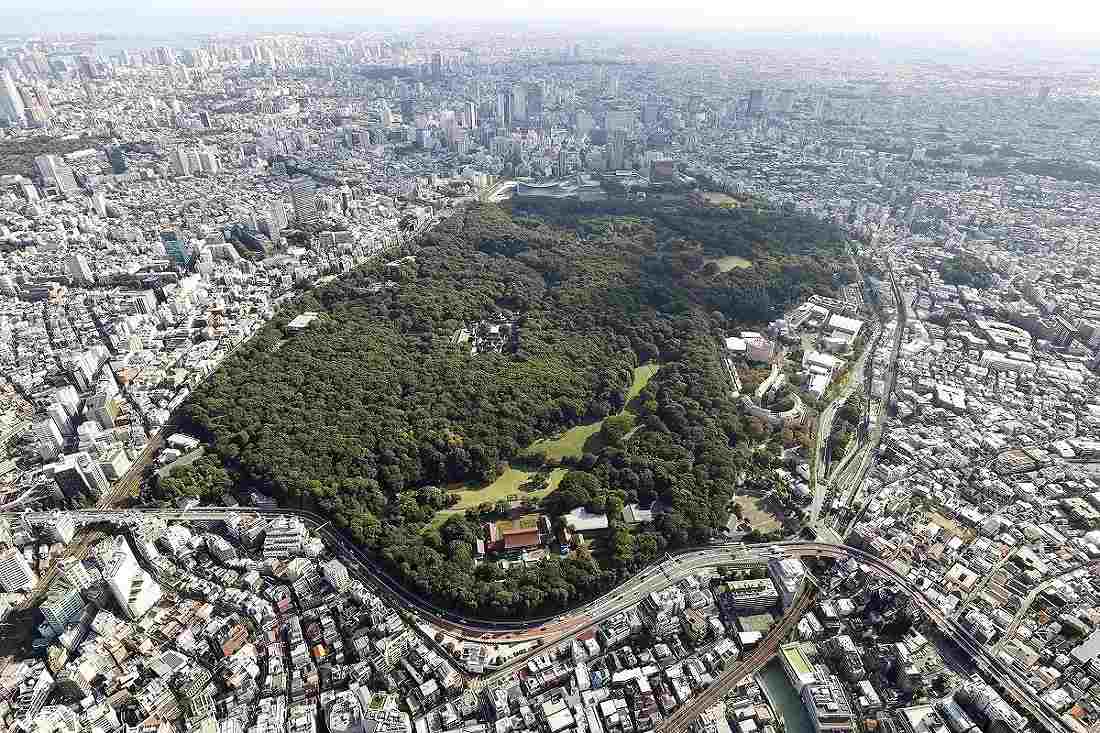
The Meiji Jingu forest in Tokyo’s Shibuya Ward is surrounded by urban buildings in this aerial photo taken Oct. 24.
10:16 JST, December 3, 2020
Meiji Jingu shrine in Shibuya Ward, Tokyo, marked the 100th anniversary of its founding last month. A great deal has happened over that time — the shrine’s man-made forest continues to grow and develop, and its structures were repaired after damage suffered in air raids during World War II. This is the first installment in a three-part series examining both the history of Meiji Jingu and its future.
***
The Jingu forest brings a sense of lushness to the concrete-covered city center, as deep green trees sway and sunlight shines through the branches, lighting the approach to the shrine. This is a place for people to relax, as well as a home for wild birds and insects.
Before Meiji Jingu was built, this 72-hectare area belonged to the Imperial family, but it was mostly agricultural land or undeveloped.
After the death of Emperor Meiji in July 1912, calls mounted in Tokyo for a shrine to honor him. The government decided in 1913 to do so and established a committee to research the matter. Chaired by Shigenobu Okuma and Takashi Hara, the panel discussed the size, cost and other details related to the shrine.
Forests and mountains have long been objects of worship in Japan, and people have honored them as places where divine spirits dwell. Local mayors and others recommended Mt. Fuji, Mt. Tsukuba, and Mt. Hakone as locations for the shrine, while business tycoon Eiichi Shibusawa was among those strongly urging that the site be in Tokyo, where it would be easier for people to visit.
The government took these opinions into account and decided to create a man-made forest in Tokyo. Sites such as the military drilling ground in Aoyama and the army’s Toyama school in present-day Shinjuku Ward were considered, but in the end, Imperial property in Yoyogi that Emperor Meiji used to frequent was selected.
The plan to plant trees for the Jingu forest was drawn up by Seiroku Honda, a forestry scholar at Tokyo Imperial University — the predecessor of the University of Tokyo — and his students Takanori Hongo and Keiji Uehara.
The current president of Fukui Prefectural University, Isoya Shinji, studied under Uehara. According to Shinji, now 76, Okuma argued that the forest should comprise cedar trees, but Honda and others countered that conifers like cedar, which are vulnerable to smoke, could not grow in an urban area.
Ultimately the forestry scholars’ position was adopted, and the forest was planted with mainly evergreen broadleaf trees such as oak, chinquapin and camphor. Uehara and others believed that if the trees planted in the area grew gradually, it would become a stable forest of broad-leaved evergreens.
The team drew up future images of the forest, and they proved to be quite accurate regarding how the forest would look 50 years and 100 years later.
“The forest has become exactly what we expected,” Shinji quoted Uehara as saying 50 years ago.
Uehara researched more than 80 shrine forests across Japan of varying ages. He believed that if different types of trees of various sizes were planted and the fallen leaves and trees were not removed, the artificial forest would gradually transform into a natural one.
Trees were donated from all over the country. The shrine buildings were built with government funds, but there was no budget for planting trees, so the Meiji Jingu construction bureau, established as an external bureau of the Home Ministry, sought contributions. The movement spread as local governments and schools launched projects to collect trees.
Fundraising campaigns to pay for the trees were actively held throughout Japan, and a total of 100,000 trees were collected. Some were planted from 1919 to 1922 by young volunteers. According to a journal on the creation of Meiji Jingu, a total of 110,000 people labored to support the planting of trees and the construction of the approach to the shrine.
The forest continues to change even today. According to research conducted in 2011 and 2012, the number of trees had dropped to about 36,000 belonging to 234 species, from about 120,000 belonging to 365 species, including tress that had already existed, at the time planting was finished. Trees that failed to adjust to the climate and soil died out, and the surviving trees became taller and thicker.
During the research, a species of bee was discovered for the first time in Japan. It was given the name “Jingu usumaruhime bachi.”
The Meiji Jingu Museum opened on the shrine’s premises in October last year, featuring a gently sloping roof with low eaves so it blends in with the surrounding forest. The museum was designed by architect Kengo Kuma, 66.
“It’s a miracle that in less than 100 years [an artificial forest] has become like a naturally grown forest,” Kuma said.







Most Read
Most read in the last 24 hours
-

Stepfather Reportedly Admits to Killing 11-Year-Old Boy Who Went ...
-

Trump Urges Extending Foreign Surveillance Program as Some Lawmak...
-

Iran Offers Proposal Allowing Ships to Exit Oman Side of Hormuz F...
-

Dead Boy's Stepfather Confessed to Killing, Police Say; Victim's ...
-

S&P 500, Nasdaq Push to Closing Records on Optimism around Middle...
-

Japan, US Agree to Intensify Communication on Exchange Rates
-

Osaka Tax Official Leaks Data to Scammers Impersonating Police Of...
-

China's Xi Calls for Strategic Clarity, Political Security with V...
Most read in the last 7 days
-
Police Find Child's Shoe During Search for Missing Boy in Nantan,...
-
Body Found in Nantan, Kyoto Prefecture, During Search for 11-Year...
-

Japanese Prime Minister Takaichi Speaks to Pakistani Prime Minist...
-

Kyoto Police Arrests Father of 11-Year-Old Boy on Suspicion of Ab...
-

Body Found in Kyoto Pref. Forest Confirmed to Be Missing 11-Year-...
-
Strong Typhoon Sinlaku Heading Toward Tokyo's Ogasawara Islands
-

No Clear Plan for Expo Site 6 Months After Close; Delays, Unpaid ...
-
Stepfather Reportedly Admits to Killing 11-Year-Old Boy Who Went ...
Most read in the last 30 days
-

Mathematician Heisuke Hironaka, Winner of Fields Medal, Dies at 9...
-
Police Find Child's Shoe During Search for Missing Boy in Nantan,...
-
Body Found in Nantan, Kyoto Prefecture, During Search for 11-Year...
-

Cherry Blossoms, Rapeseed Flowers Perform Colorful ‘Duet’ in Niig...
-
New Bird Species Confirmed in Japan for 1st Time in 45 Years, Fou...
-

Nori Prices Surge in Japan Due to Poor Seaweed Production Amid Ri...
-

Earthquake Jolts Kansai Region, Recording Magnitude 4.2, Japanese...
-

Cherry Blossoms in Full Bloom Draw Crowds in Sendai, Miyagi Pref....
Top Articles in Society
-
Police Find Child’s Shoe During Search for Missing Boy in Nantan, Kyoto Prefecture
-
Body Found in Nantan, Kyoto Prefecture, During Search for 11-Year-Old Boy in Area (Update 1)
-
Cherry Blossoms, Rapeseed Flowers Perform Colorful ‘Duet’ in Niigata
-
New Bird Species Confirmed in Japan for 1st Time in 45 Years, Found on Tokara Islands in Kagoshima Pref.
-
Earthquake Jolts Kansai Region, Recording Magnitude 4.2, Japanese Seismic Intensity Scale 3
JN ACCESS RANKING
-
Police Find Child’s Shoe During Search for Missing Boy in Nantan, Kyoto Prefecture
-
Body Found in Nantan, Kyoto Prefecture, During Search for 11-Year-Old Boy in Area (Update 1)
-
Cherry Blossoms, Rapeseed Flowers Perform Colorful ‘Duet’ in Niigata
-
New Bird Species Confirmed in Japan for 1st Time in 45 Years, Found on Tokara Islands in Kagoshima Pref.
-
Nori Prices Surge in Japan Due to Poor Seaweed Production Amid Rising Sea Temps; Price of Onigiri Rice Balls Also Impacted
Most read in the last 24 hours
-
Stepfather Reportedly Admits to Killing 11-Year-Old Boy Who Went ...
-
Trump Urges Extending Foreign Surveillance Program as Some Lawmak...
-
Iran Offers Proposal Allowing Ships to Exit Oman Side of Hormuz F...
-
Dead Boy's Stepfather Confessed to Killing, Police Say; Victim's ...
-
S&P 500, Nasdaq Push to Closing Records on Optimism around Middle...
Most read in the last 7 days
-
Police Find Child's Shoe During Search for Missing Boy in Nantan,...
-
Body Found in Nantan, Kyoto Prefecture, During Search for 11-Year...
-
Japanese Prime Minister Takaichi Speaks to Pakistani Prime Minist...
-
Kyoto Police Arrests Father of 11-Year-Old Boy on Suspicion of Ab...
-
Body Found in Kyoto Pref. Forest Confirmed to Be Missing 11-Year-...
Most read in the last 30 days
-
Mathematician Heisuke Hironaka, Winner of Fields Medal, Dies at 9...
-
Police Find Child's Shoe During Search for Missing Boy in Nantan,...
-
Body Found in Nantan, Kyoto Prefecture, During Search for 11-Year...
-
Cherry Blossoms, Rapeseed Flowers Perform Colorful ‘Duet’ in Niig...
-
New Bird Species Confirmed in Japan for 1st Time in 45 Years, Fou...