
Tokyo’s 23 Wards Mull Charging Fees for Garbage Collection Service, Plan Aims to Reduce Waste, Increase Awareness
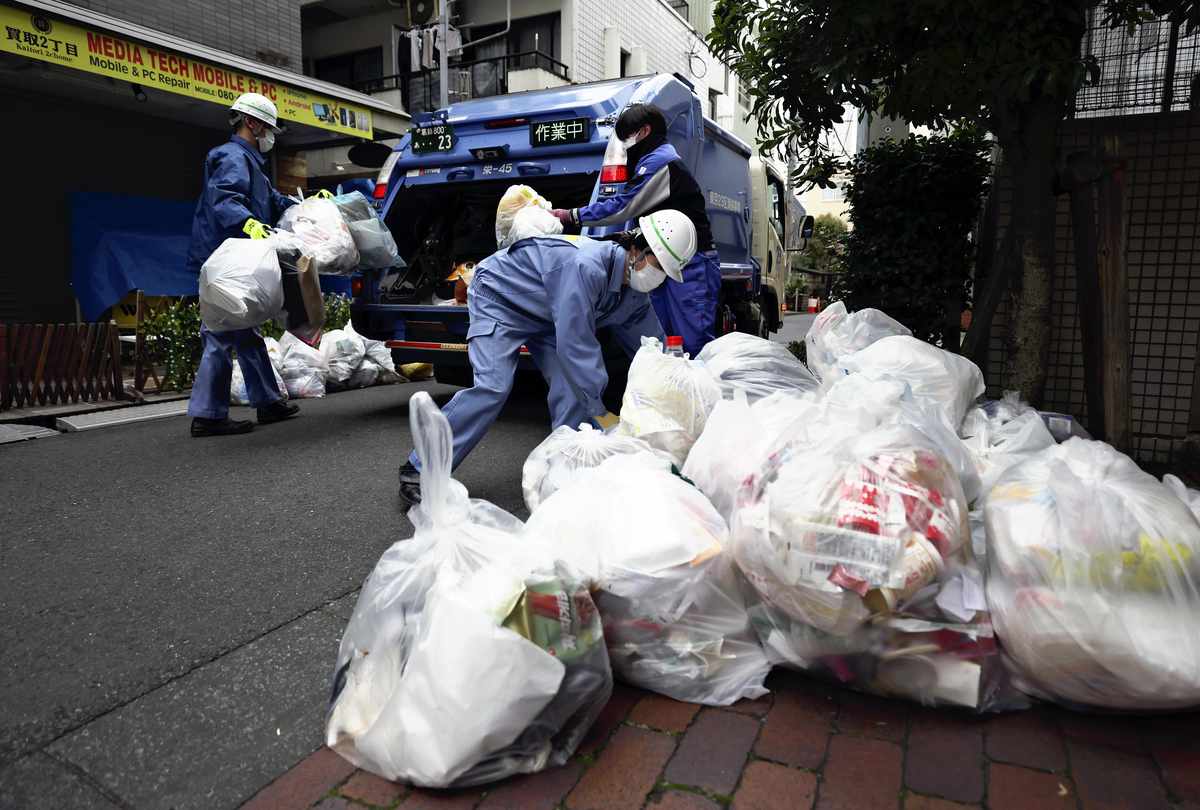
Workers collect garbage at a trash collection site in Shinjuku Ward, Tokyo, on March 17.
11:35 JST, March 29, 2026
Tokyo’s 23 wards have begun considering charging fees for their service to collect household waste, it has been learned. With 70% of local governments nationwide already introducing such a system, the Tokyo metropolitan government, which operates waste disposal facilities, is backing the move.
The pillar of the proposal calls for charging ¥1 per liter of waste, with a simultaneous introduction across all wards starting in fiscal 2037. However, with unified local elections scheduled for next year, some wards remain cautious, citing concerns over increased costs and backlash from residents.
Becoming full in half a century
On the morning of March 17, a garbage truck arrived at a collection point in Hyakunincho, Shinjuku Ward, Tokyo, and began collecting the mountains of garbage bags piled up there. The area is home to many foreign residents and is dotted with restaurants serving Asian and other international cuisines, as well as minpaku private lodgings.
Although it was a collection day for combustible waste, some bags contained other items, such as cans and plastic bottles.
“If sorting is inadequate, the volume increases. We provide guidance in multiple languages, but people just don’t seem to understand,” said a senior official at the ward’s Kabukicho garbage collection center.
The annual amount of waste collected by the 23 wards totaled about 1.6 million tons in fiscal 2024. It is incinerated at plants and then landfilled at the metropolitan government’s disposal site in Tokyo Bay. As the disposal site is expected to be filled up in about half a century, Tokyo Gov. Yuriko Koike made an appeal to the wards in January.
“I hope we can work together to promote measures that contribute to recycling of resources while demonstrating the significance and effectiveness of charging fees [for garbage collection],” she said.
The association comprising the mayors of the 23 wards estimated that the amount of waste will be reduced by about 10% by setting the price of designated garbage bags at ¥1 per liter, based on examples seen in other municipalities.
Huge additional burden
To prevent violations of the rules, the association is eyeing a full transition to a door-to-door collection system, under which garbage will be collected from individual households. But this is expected to complicate operations and require increasing personnel and collection vehicles by 50%, resulting in an additional annual cost of about ¥22 billion.
The association also notes that if the new system is introduced at a different time, there is a risk that garbage will be dumped beyond borders in wards where garbage collection remains free. It is expected to take some time until a consensus is reached among all wards and ward ordinances are amended.
Ahead of mayor elections
However, the 23 ward mayors do not all share the same stance. When surveyed by The Yomiuri Shimbun, seven expressed support.
“Reducing waste is essential to making waste management sustainable,” Edogawa Mayor Takeshi Saito replied. “It will lead to greater awareness among residents and a fair burden based on the amount of waste produced,” Meguro Mayor Eiji Aoki said.
But a majority of 12 answered that they could not say either way. Voices calling for cautious consideration were more prominent.
“It will place a new burden on residents,” Nakano Mayor Naoto Sakai said. “Increased burdens on residents and administrative costs are a concern,” said Setagaya Mayor Nobuto Hosaka. Some other mayors refrained from making clear their positions, citing reasons such as “The issue is being examined among the 23 wards as a whole.”
Eighteen of the 23 wards are scheduled to hold mayoral elections between this year and next. “I’m actually in favor of the plan, but the idea of collecting fees, which will increase financial burdens, would be unpopular with residents,” said one of the mayors who did not clarify their position. “There may be mayors who want to avoid ‘free collection’ becoming a key issue in the mayoral election.”
70% charging fees nationwide
According to the Environment Ministry and other sources, 1,169 local governments, or about 70% of the nation’s 1,741, have begun charging for household waste collection, including partial collection. Among the 30 municipalities in Tokyo, excluding the 23 wards and islands, Hinohara Village is the only one that offers a free collection service.
The city of Hachioji in western Tokyo introduced a fee-based system in 2004 following more than 1,700 public briefings. As a result, the volume of waste in fiscal year 2024 decreased to about 14,000 tons, or two-thirds of the level before the initiative was introduced.
“The system helped raise citizens’ awareness about waste reduction, sorting and recycling,” a city official said. “People’s manners regarding waste disposal have also improved.”
The city of Kyoto, which introduced the system in 2006, does not provide door-to-door collection for residents excluding those with disabilities and certain others. Garbage bags that do not follow the rules are left at waste collection sites with warning stickers attached.
The amount of garbage in the city has decreased significantly from about 820,000 tons in fiscal 2000 to about 370,000 tons in fiscal 2024.
“Residents’ understanding has improved through explanatory meetings and warning stickers, and no major problems have been reported,” said a city official.


Related Tags






Most Read
Most read in the last 24 hours
-

Stepfather Reportedly Admits to Killing 11-Year-Old Boy Who Went ...
-

Trump Urges Extending Foreign Surveillance Program as Some Lawmak...
-

Iran Offers Proposal Allowing Ships to Exit Oman Side of Hormuz F...
-

S&P 500, Nasdaq Push to Closing Records on Optimism around Middle...
-

Pakistani Delegation Meets in Tehran Hoping for More US-Iran Talk...
-

Govt to Tighten Controls over Weapons after Export with New Rules...
-

Japan, US Agree to Intensify Communication on Exchange Rates
-

China's Xi Calls for Strategic Clarity, Political Security with V...
Most read in the last 7 days
-
Police Find Child's Shoe During Search for Missing Boy in Nantan,...
-

Body Found in Nantan, Kyoto Prefecture, During Search for 11-Year...
-

Japanese Prime Minister Takaichi Speaks to Pakistani Prime Minist...
-

Kyoto Police Arrests Father of 11-Year-Old Boy on Suspicion of Ab...
-

Body Found in Kyoto Pref. Forest Confirmed to Be Missing 11-Year-...
-
Strong Typhoon Sinlaku Heading Toward Tokyo's Ogasawara Islands
-

No Clear Plan for Expo Site 6 Months After Close; Delays, Unpaid ...
-
Kyoto Boy Missing for 20 Days; Largescale Search Continues in Nan...
Most read in the last 30 days
-

Mathematician Heisuke Hironaka, Winner of Fields Medal, Dies at 9...
-
Police Find Child's Shoe During Search for Missing Boy in Nantan,...
-
Body Found in Nantan, Kyoto Prefecture, During Search for 11-Year...
-

Cherry Blossoms, Rapeseed Flowers Perform Colorful ‘Duet’ in Niig...
-

New Bird Species Confirmed in Japan for 1st Time in 45 Years, Fou...
-

Nori Prices Surge in Japan Due to Poor Seaweed Production Amid Ri...
-

Earthquake Jolts Kansai Region, Recording Magnitude 4.2, Japanese...
-

Cherry Blossoms in Full Bloom Draw Crowds in Sendai, Miyagi Pref....
Top Articles in Society
-
Police Find Child’s Shoe During Search for Missing Boy in Nantan, Kyoto Prefecture
-
Body Found in Nantan, Kyoto Prefecture, During Search for 11-Year-Old Boy in Area (Update 1)
-
Cherry Blossoms, Rapeseed Flowers Perform Colorful ‘Duet’ in Niigata
-
New Bird Species Confirmed in Japan for 1st Time in 45 Years, Found on Tokara Islands in Kagoshima Pref.
-
Earthquake Jolts Kansai Region, Recording Magnitude 4.2, Japanese Seismic Intensity Scale 3
JN ACCESS RANKING
-
Police Find Child’s Shoe During Search for Missing Boy in Nantan, Kyoto Prefecture
-
Body Found in Nantan, Kyoto Prefecture, During Search for 11-Year-Old Boy in Area (Update 1)
-
Cherry Blossoms, Rapeseed Flowers Perform Colorful ‘Duet’ in Niigata
-
New Bird Species Confirmed in Japan for 1st Time in 45 Years, Found on Tokara Islands in Kagoshima Pref.
-
Nori Prices Surge in Japan Due to Poor Seaweed Production Amid Rising Sea Temps; Price of Onigiri Rice Balls Also Impacted
Most read in the last 24 hours
-
Stepfather Reportedly Admits to Killing 11-Year-Old Boy Who Went ...
-
Trump Urges Extending Foreign Surveillance Program as Some Lawmak...
-
Iran Offers Proposal Allowing Ships to Exit Oman Side of Hormuz F...
-
S&P 500, Nasdaq Push to Closing Records on Optimism around Middle...
-
Pakistani Delegation Meets in Tehran Hoping for More US-Iran Talk...
Most read in the last 7 days
-
Police Find Child's Shoe During Search for Missing Boy in Nantan,...
-
Body Found in Nantan, Kyoto Prefecture, During Search for 11-Year...
-
Japanese Prime Minister Takaichi Speaks to Pakistani Prime Minist...
-
Kyoto Police Arrests Father of 11-Year-Old Boy on Suspicion of Ab...
-
Body Found in Kyoto Pref. Forest Confirmed to Be Missing 11-Year-...
Most read in the last 30 days
-
Mathematician Heisuke Hironaka, Winner of Fields Medal, Dies at 9...
-
Police Find Child's Shoe During Search for Missing Boy in Nantan,...
-
Body Found in Nantan, Kyoto Prefecture, During Search for 11-Year...
-
Cherry Blossoms, Rapeseed Flowers Perform Colorful ‘Duet’ in Niig...
-
New Bird Species Confirmed in Japan for 1st Time in 45 Years, Fou...