
15:52 JST, February 16, 2021
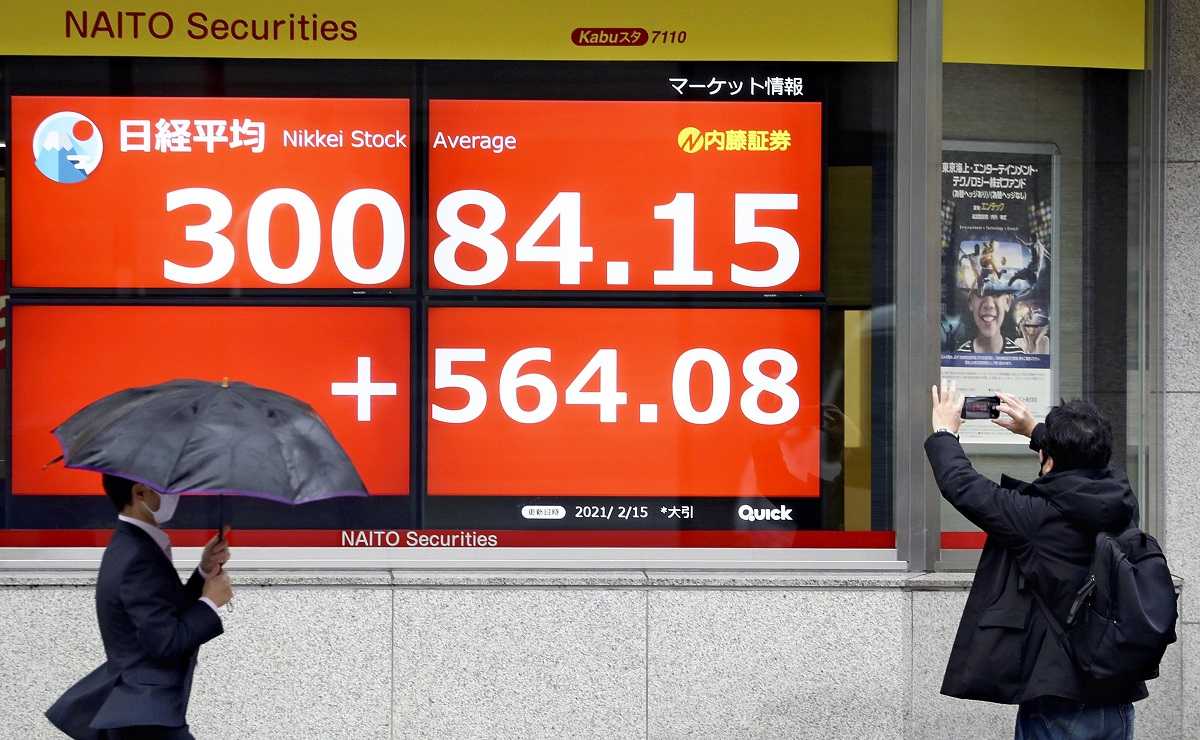
After 30½ years, the Nikkei Stock Average regained a key threshold, closing above 30,000 on Monday. Stock prices have been propped up by the flow of investment into Japan due to the massive monetary easing policies carried out by central banks around the world, including the Bank of Japan.
With the employment and income environment severe amid the novel coronavirus pandemic, however, the benefits of higher stock prices have not spread to a wide range of sectors.
While concerns about an overheated market persists, there is also the risk that a tightening of monetary policy will reverse the flow of investment.
BOJ props up shares
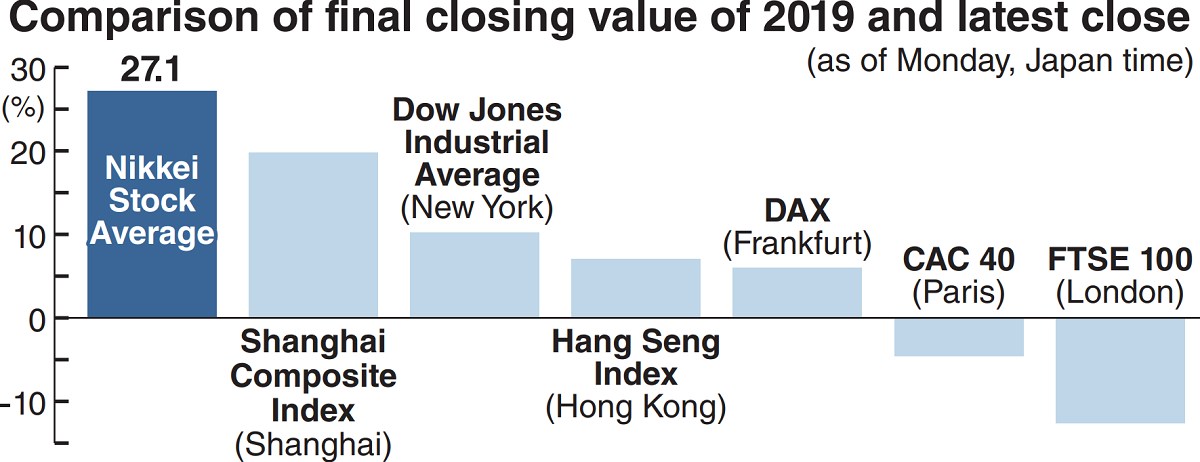
Central banks around the world have stepped up monetary easing to support their economies due to the effects of the pandemic. Although stock indexes have also risen in the United States and China, the Nikkei Stock Average ended Monday up a whopping 27.1% compared to its final closing value of 2019.
The Bank of Japan is one of the reasons for this rise, as it is the only major central bank in the world to purchase massive amounts of exchange-traded funds (ETFs). Throughout all of 2020, the BOJ purchased a record ¥7.1 trillion worth of ETFs.
The stock market now regularly expects a certain level of purchases from the BOJ.
With long-term interest rates near zero, investors are focusing on riskier stocks rather than bonds for the chance to make a profit.
According to Makoto Sengoku, a senior equity market analyst at Tokai Tokyo Research Institute Co., stock prices are unlikely to fall unless the Bank of Japan sells its holdings. This sense of security has led to an increase in purchases of stocks.
Another major factor is a change in the conventional wisdom that a stronger yen leads to lower stock prices. The dollar is currently at ¥105, meaning that the yen has gotten stronger by ¥20 from six years ago.
Japanese companies that have a high export ratio face a disadvantage with a stronger yen. As more factories are moved overseas, however, the cost structure is less sensitive to exchange rates than in the past, instead supporting Japanese firms’ performance.
Gap with real economy
The real economy is in a slump, however, as many people don’t receive any benefit from higher stock prices.
Individual investors hold less than 20% of all shares.
Also, the number of people unemployed in 2020 increased for the first time in 11 years to 1.91 million.
Furthermore, household consumption plunged, leaving a huge gap between stock prices and the real economy.
This situation where stock indexes rise amid a recession continued even after the government declared another pandemic-related state of emergency in January this year.
There is lingering public discontent that only a few wealthy people are benefiting from the higher stock prices.
“Stimulating personal consumption is indispensable for lifting up the real economy,” Yoshinori Isozaki, the president of Kirin Holdings Co., said at a press conference on Monday. “Consumer spending was strong 30 years ago, but now the opposite is true, and consumers are inclined to save money.”
Shingo Ide, chief financial engineer at the NLI Research Institute, said: “Industries that have been hit hard by the novel coronavirus crisis, such as restaurants and leisure, have many workers, but few of the companies in these industries are listed on the stock exchange. So even if stock prices rise, there won’t be much enthusiasm.”







Most Read
Most read in the last 24 hours
-

Stepfather Reportedly Admits to Killing 11-Year-Old Boy Who Went ...
-

Dead Boy's Stepfather Confessed to Killing, Police Say; Victim's ...
-

Japan’s Coffee Bean Production Looks to Northern Areas to Expand ...
-

4 Injured as Pipe Bursts at Semiconductor-Related Company’s Facto...
-

Osaka Tax Official Leaks Data to Scammers Impersonating Police Of...
-

Cherry Blossoms in Full Bloom Across Iwate Prefecture, Bringing S...
-

Sexual Abuse Allegations Are Spurring Calls for a Broader Reckoni...
-

Stable Imperial Succession: Debate the Issue without Excluding Fe...
Most read in the last 7 days
-
Police Find Child's Shoe During Search for Missing Boy in Nantan,...
-
Body Found in Nantan, Kyoto Prefecture, During Search for 11-Year...
-
Japanese Prime Minister Takaichi Speaks to Pakistani Prime Minist...
-

Kyoto Police Arrests Father of 11-Year-Old Boy on Suspicion of Ab...
-

Body Found in Kyoto Pref. Forest Confirmed to Be Missing 11-Year-...
-
Strong Typhoon Sinlaku Heading Toward Tokyo's Ogasawara Islands
-

No Clear Plan for Expo Site 6 Months After Close; Delays, Unpaid ...
-
Stepfather Reportedly Admits to Killing 11-Year-Old Boy Who Went ...
Most read in the last 30 days
-
Mathematician Heisuke Hironaka, Winner of Fields Medal, Dies at 9...
-
Police Find Child's Shoe During Search for Missing Boy in Nantan,...
-
Body Found in Nantan, Kyoto Prefecture, During Search for 11-Year...
-

Cherry Blossoms, Rapeseed Flowers Perform Colorful ‘Duet’ in Niig...
-

New Bird Species Confirmed in Japan for 1st Time in 45 Years, Fou...
-
Nori Prices Surge in Japan Due to Poor Seaweed Production Amid Ri...
-

Earthquake Jolts Kansai Region, Recording Magnitude 4.2, Japanese...
-

Cherry Blossoms in Full Bloom Draw Crowds in Sendai, Miyagi Pref....
Top Articles in Business
-

Middle Powers Should Create Alternative to WTO, Says Research Group
-

Japan to Release Oil from National Reserve Starting Thursday
-

Luggage Storage Services in Japan Diversify in Effort to Boost ‘Hands-free’ Tourism, Address Overtourism
-

Nissan’s New Elgrand to Allow Hands-Free Driving Even in Urban Areas in Push for Domestic Market Turnaround
-

AI Development Firm Established to Develop Japanese 1-Trillion-Parameter Models, With Funding from SoftBank, NEC, Honda, Sony
JN ACCESS RANKING
-
Police Find Child’s Shoe During Search for Missing Boy in Nantan, Kyoto Prefecture
-
Body Found in Nantan, Kyoto Prefecture, During Search for 11-Year-Old Boy in Area (Update 1)
-
Cherry Blossoms, Rapeseed Flowers Perform Colorful ‘Duet’ in Niigata
-
New Bird Species Confirmed in Japan for 1st Time in 45 Years, Found on Tokara Islands in Kagoshima Pref.
-
Nori Prices Surge in Japan Due to Poor Seaweed Production Amid Rising Sea Temps; Price of Onigiri Rice Balls Also Impacted
Most read in the last 24 hours
-
Stepfather Reportedly Admits to Killing 11-Year-Old Boy Who Went ...
-
Dead Boy's Stepfather Confessed to Killing, Police Say; Victim's ...
-
Japan’s Coffee Bean Production Looks to Northern Areas to Expand ...
-
4 Injured as Pipe Bursts at Semiconductor-Related Company’s Facto...
-
Osaka Tax Official Leaks Data to Scammers Impersonating Police Of...
Most read in the last 7 days
-
Police Find Child's Shoe During Search for Missing Boy in Nantan,...
-
Body Found in Nantan, Kyoto Prefecture, During Search for 11-Year...
-
Japanese Prime Minister Takaichi Speaks to Pakistani Prime Minist...
-
Kyoto Police Arrests Father of 11-Year-Old Boy on Suspicion of Ab...
-
Body Found in Kyoto Pref. Forest Confirmed to Be Missing 11-Year-...
Most read in the last 30 days
-
Mathematician Heisuke Hironaka, Winner of Fields Medal, Dies at 9...
-
Police Find Child's Shoe During Search for Missing Boy in Nantan,...
-
Body Found in Nantan, Kyoto Prefecture, During Search for 11-Year...
-
Cherry Blossoms, Rapeseed Flowers Perform Colorful ‘Duet’ in Niig...
-
New Bird Species Confirmed in Japan for 1st Time in 45 Years, Fou...