
Heirs to Kyoto Talent / Dyer Adds Life to Cloth with Color from Plants Applying Sharp Eye to Centuries-old Techniques
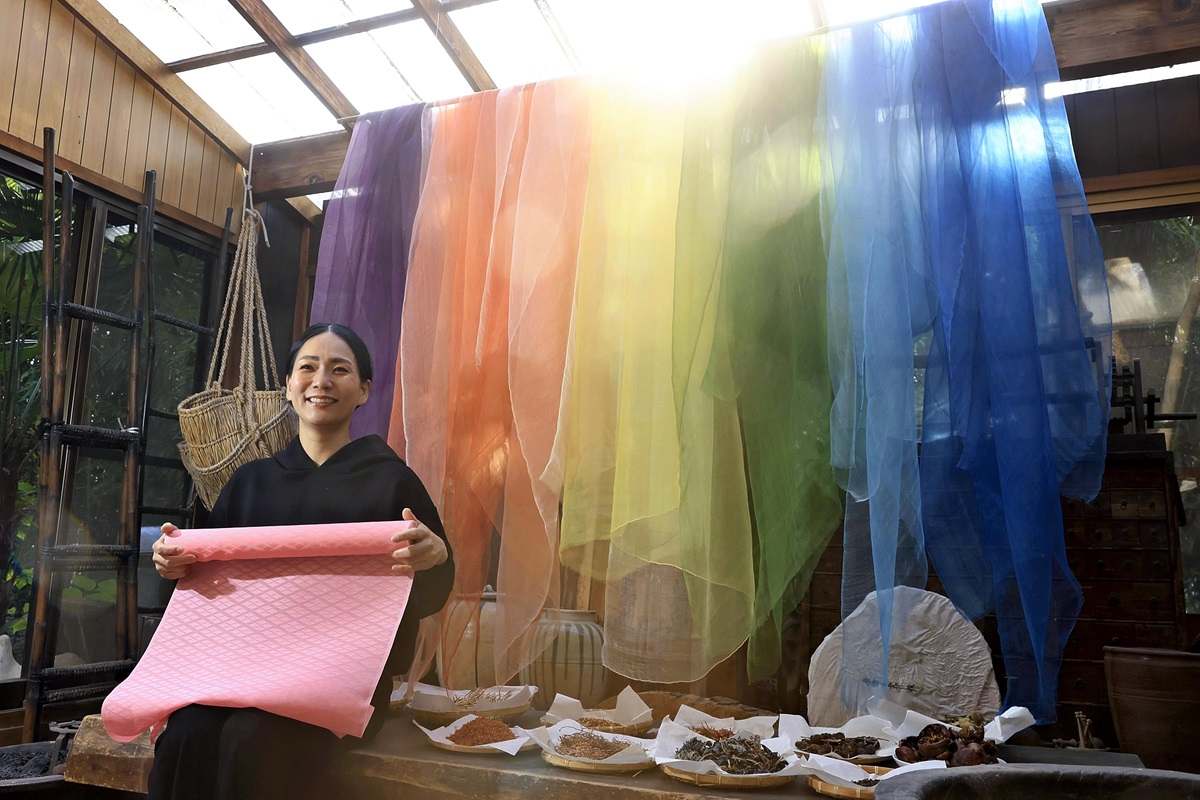
Sarasa Yoshioka sits beside dried plants used for dyeing in Fushimi Ward, Kyoto.

11:24 JST, February 10, 2024
KYOTO — Sarasa Yoshioka seems to be able to imagine colors that can be harvested from plants — such as gromwell roots, safflower petals, madder roots and acorns.
She dissolves the pigments extracted from plants in water that was pumped up from 100 meters underground, and soaks a plain cloth of silk, linen or cotton in it.
Initially, she has no guarantee of what the color will be. Scrutinizing with a sharp eye, she makes fine adjustment, gradually getting closer and closer to the color she envisions.
Dyeing and weaving artist Yoshioka is the sixth-generation master dyer of Textile Dyer Yoshioka, or Some no Tsukasa Yoshioka in Japanese, a business that dates back to the 1800s.
“We have an expression, ‘wet color of a dyehouse,’” she said.
The most beautiful colors are those of freshly dyed cloth that is still wet when it is hung up to dry, she explained. “This is a privilege that only the dyer can see.”

Yoshioka puts the plants in hot water to release the color.
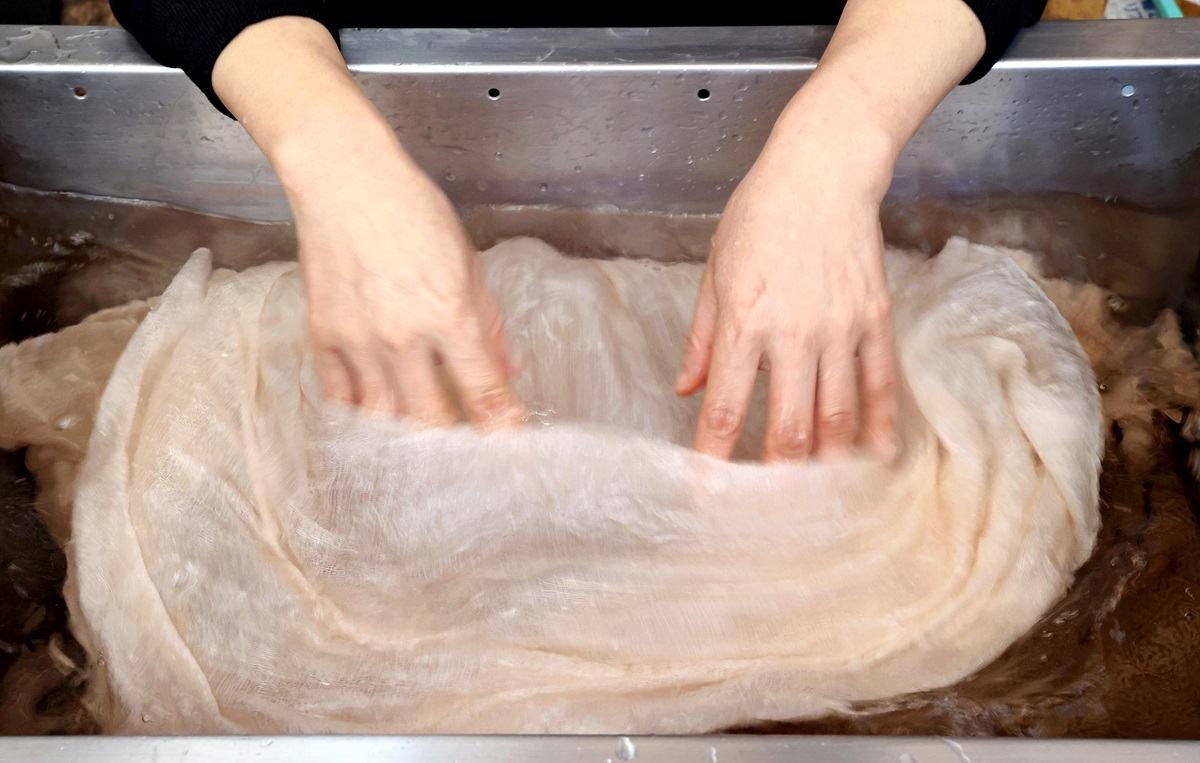
Cloth is dyed to an ideal color over time.
No synthetic dyes
In the past, there were many dyehouses in Kyoto bearing the name “Yoshioka.”
The first generation of Textile Dyer Yoshioka, who was granted the right to use the name, founded the business in the Tanoji area in the center of the city.
When modernization during the Meiji era (1868-1912) led to the spread of chemical dyes, Yoshioka’s grandfather and the fourth-generation head of the shop, Tsuneo, was inspired by the beauty of the Shoso-in treasures and began researching natural dyes harvested from plants. Tsuneo moved his workshop to the current location near the Uji River in Fushimi Ward, Kyoto.
The shop’s fifth-generation head was Yoshioka’s father, Sachio, who made a decision not to use any synthetic dyes. He pursued the beauty of natural colors using ancient techniques that employed dyes harvested from plants. He became a leading color historian.
Yoshioka was his third daughter. Her earliest childhood memory is of a workshop with the smell of dyes and steam rising from the air.
After graduating from university, Yoshioka’s interest in the family business grew as she learned about clothing as a sales representative for a fashion brand.
Her father recommended that she work at the Nomura Silk Museum in Seiyo, Ehime Prefecture. For two years in the town where sericulture flourished, she acquired practical knowledge ranging from yarn-making to dyeing and weaving.
She began her training at a local workshop in 2008, when she was over 30 years old. It took about five years before she was able to produce the colors she intended.
She has been entrusted with the task of dyeing artificial camellia flowers for the annual Shunie ceremony, also known as Omizutori, at Todaiji temple in Nara.
In 2019, her father passed away from a heart attack while on a trip. Unprepared, she assumed the position of the sixth-generation head of the dyehouse.
Bringing nature closer
She remembers that when she asked her father why people dye cloth and clothes, he told her about his experience of being moved by the beauty of nature such as the sun, the moon, the sky, the ocean, mountains, rivers, trees, flowers and grass.
He thought that dyeing cloth began when people started to think about how to bring this beauty closer to themselves, she said.
The workshop’s technique of using natural dyes harvested from plants is not different from ancient techniques used in the eighth and ninth centuries.
Guided by her predecessors, Yoshioka came into contact with classical literature. In “The Tale of Genji,” for example, author Murasaki Shikibu describes the characters’ costumes in great detail.
“I don’t know exactly what kind of colors they are, but when I let my imagination run wild, I can link them to what I’m dyeing,” she said.
All colors may theoretically be considered as combinations of cyan, magenta and yellow. Nowadays, we can represent colors in any number of ways with computers. Even so, she believes that colors extracted from natural plants have a depth that evokes “warmth” and “the source of life,” as her father used to say.
She is sometimes overwhelmed by the history of her predecessors. But now, she shares her thoughts with them. She has come to love the colors harvested from plants: “They allow me to feel the four seasons of Kyoto and the workings of nature,” she said.
***
If you are interested in the original Japanese version of this story, click here.








Most Read
Most read in the last 24 hours
-

Stepfather Reportedly Admits to Killing 11-Year-Old Boy Who Went ...
-

Trump Urges Extending Foreign Surveillance Program as Some Lawmak...
-

Iran Offers Proposal Allowing Ships to Exit Oman Side of Hormuz F...
-

S&P 500, Nasdaq Push to Closing Records on Optimism around Middle...
-

Pakistani Delegation Meets in Tehran Hoping for More US-Iran Talk...
-

Govt to Tighten Controls over Weapons after Export with New Rules...
-

Japan, US Agree to Intensify Communication on Exchange Rates
-

China's Xi Calls for Strategic Clarity, Political Security with V...
Most read in the last 7 days
-
Police Find Child's Shoe During Search for Missing Boy in Nantan,...
-
Body Found in Nantan, Kyoto Prefecture, During Search for 11-Year...
-

Japanese Prime Minister Takaichi Speaks to Pakistani Prime Minist...
-

Kyoto Police Arrests Father of 11-Year-Old Boy on Suspicion of Ab...
-

Body Found in Kyoto Pref. Forest Confirmed to Be Missing 11-Year-...
-
Strong Typhoon Sinlaku Heading Toward Tokyo's Ogasawara Islands
-

No Clear Plan for Expo Site 6 Months After Close; Delays, Unpaid ...
-
Kyoto Boy Missing for 20 Days; Largescale Search Continues in Nan...
Most read in the last 30 days
-
Mathematician Heisuke Hironaka, Winner of Fields Medal, Dies at 9...
-
Police Find Child's Shoe During Search for Missing Boy in Nantan,...
-
Body Found in Nantan, Kyoto Prefecture, During Search for 11-Year...
-

Cherry Blossoms, Rapeseed Flowers Perform Colorful ‘Duet’ in Niig...
-
New Bird Species Confirmed in Japan for 1st Time in 45 Years, Fou...
-

Nori Prices Surge in Japan Due to Poor Seaweed Production Amid Ri...
-

Earthquake Jolts Kansai Region, Recording Magnitude 4.2, Japanese...
-

Cherry Blossoms in Full Bloom Draw Crowds in Sendai, Miyagi Pref....
Top Articles in Features
-
Cherry Blossoms in Full Bloom Draw Crowds in Sendai, Miyagi Pref.; Aquarium Creates Underwater ‘Cherry Blossom Viewing’ Show
-

Cherry Blossom Viewing Season at Peak in Japan’s Kanazawa
-
Cherry Blossoms, Tulips, Snow-Capped Peaks Create Picturesque Scene in Toyama Pref., Japan
-
Cherry Blossom Viewers Enjoy Picnic Under the Trees in Full Bloom in Famous Osaka Spot
-

Cherry Blossom View in Front of Shinkansen Bullet Trains Attracting Visitors in Nagasaki Pref.
JN ACCESS RANKING
-
Police Find Child’s Shoe During Search for Missing Boy in Nantan, Kyoto Prefecture
-
Body Found in Nantan, Kyoto Prefecture, During Search for 11-Year-Old Boy in Area (Update 1)
-
Cherry Blossoms, Rapeseed Flowers Perform Colorful ‘Duet’ in Niigata
-
New Bird Species Confirmed in Japan for 1st Time in 45 Years, Found on Tokara Islands in Kagoshima Pref.
-
Nori Prices Surge in Japan Due to Poor Seaweed Production Amid Rising Sea Temps; Price of Onigiri Rice Balls Also Impacted
Most read in the last 24 hours
-
Stepfather Reportedly Admits to Killing 11-Year-Old Boy Who Went ...
-
Trump Urges Extending Foreign Surveillance Program as Some Lawmak...
-
Iran Offers Proposal Allowing Ships to Exit Oman Side of Hormuz F...
-
S&P 500, Nasdaq Push to Closing Records on Optimism around Middle...
-
Pakistani Delegation Meets in Tehran Hoping for More US-Iran Talk...
Most read in the last 7 days
-
Police Find Child's Shoe During Search for Missing Boy in Nantan,...
-
Body Found in Nantan, Kyoto Prefecture, During Search for 11-Year...
-
Japanese Prime Minister Takaichi Speaks to Pakistani Prime Minist...
-
Kyoto Police Arrests Father of 11-Year-Old Boy on Suspicion of Ab...
-
Body Found in Kyoto Pref. Forest Confirmed to Be Missing 11-Year-...
Most read in the last 30 days
-
Mathematician Heisuke Hironaka, Winner of Fields Medal, Dies at 9...
-
Police Find Child's Shoe During Search for Missing Boy in Nantan,...
-
Body Found in Nantan, Kyoto Prefecture, During Search for 11-Year...
-
Cherry Blossoms, Rapeseed Flowers Perform Colorful ‘Duet’ in Niig...
-
New Bird Species Confirmed in Japan for 1st Time in 45 Years, Fou...