

People wanting to work as volunteers line up at a reception desk in Kurashiki, Okayama Prefecture, in July 2018.
18:56 JST, October 21, 2025
When a disaster occurs, volunteers play an important role in helping damage-hit residents rebuild their lives. However, in disaster-struck areas where there is a high level of risk, volunteers themselves need to consider how to ensure their own safety.
It is recommended that volunteers review the basics of carrying out their activities safely.
Medical services in disaster-hit areas tend to struggle. Nobuyuki Kurita, president of Rescue Stock Yard, a nonprofit organization certified to carry out relief activities in disaster-hit areas, said, “To avoid causing trouble, it is important that volunteers ensure their own safety.”
***
First of all, when calm, they should check whether they feel physically well.
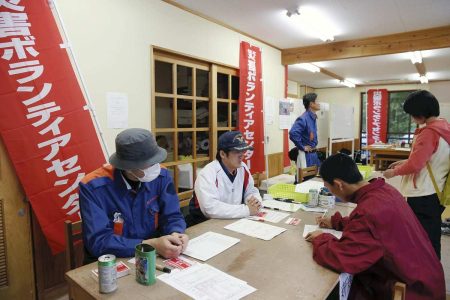
A volunteer, front right, registers at a volunteer center in Minami-Aso, Kumamoto Prefecture, in April 2016.
It is necessary to find out in advance what types of volunteers are sought after. Then, they should apply for a volunteer insurance plan at the social welfare council in their local municipality before departing.
There can be a lot of dirt and dust in the air in disaster-hit areas. Volunteers should wear a mask and goggles. Since cotton work gloves absorb water, rubber gloves are best.
To prevent feet from being pierced by nails and other sharp objects, volunteers should wear high boots or sports shoes with steel plates inserted to prevent accidents. If other kinds of inserts to prevent feet from being pierced are available, it is OK to use them.
During activity orientations, dangerous places and off-limit zones are explained. Volunteers should listen very carefully.
If there is a risk of tsunami, it is best to confirm places for evacuation.
There may be cases in which volunteers will be asked to do risky work that they did not expect. In such cases, they need to say, “I cannot do that,” or consult volunteer centers.
Kurita urged, “It is important not to work beyond your abilities. If you feel anxious, you should consult somebody and carry out tasks without becoming overconfident.”
Prevent stress, heat stroke

There will be cases of volunteers witnessing damage or hearing about survivors’ experiences.
Yukari Maeda, a nurse and adviser in the Japanese Red Cross Society’s department for life saving and welfare, said: “Volunteers can also suffer from stress. You must never believe, ‘I’m different and all right.’”
Maeda pointed out self-care is important, saying, “It is natural to feel sympathy, imagining the same thing that happened to a survivor happening to yourself and becoming emotional.”
Concerning their feelings and the scenes volunteers may witness, simply talking to fellow volunteers or others whom they trust can reduce stress.
If you are not good at chatting, it is recommended to write down your feelings in a notebook.
“Volunteers are also victims behind the scenes. Verbalizing what you felt can ease confused feelings in your mind,” Maeda said.
In the hot summer season, volunteers need to be careful about heat stroke. “When people focus on the work, they tend to forget to take steps to prevent heat stroke,” Maeda said.
Volunteers need to sleep well and eat enough breakfast. If you feel even a little bit physically unwell, be sure to not do too much. It is also necessary to rest at intervals, such as every 30 minutes.
Make sure to hydrate before you get thirsty. “Never drink too little just because you have less time to go to the restroom. You need to drink water and also intake salt regularly,” Maeda said.






Most Read
Most read in the last 24 hours
-

Japan’s Coffee Bean Production Looks to Northern Areas to Expand ...
-

4 Injured as Pipe Bursts at Semiconductor-Related Company’s Facto...
-

Osaka Tax Official Leaks Data to Scammers Impersonating Police Of...
-

A 10-Day Ceasefire Agreed on by Israel and Lebanon Goes into Effe...
-
Imperial Household Agency Presses for ‘Urgent’ Debate to Stabiliz...
-

Japan, EU Set to Hold First Defense Industry Dialogue, Private-Se...
-

Wall Street Sets Another Record after US Stocks Tick Higher
-

Taiwan's Chipmaker TSMC Reports 58% Jump in Profit, Warns about I...
Most read in the last 7 days
-
Police Find Child's Shoe During Search for Missing Boy in Nantan,...
-
Body Found in Nantan, Kyoto Prefecture, During Search for 11-Year...
-

Japanese Prime Minister Takaichi Speaks to Pakistani Prime Minist...
-

Kyoto Police Arrests Father of 11-Year-Old Boy on Suspicion of Ab...
-

Body Found in Kyoto Pref. Forest Confirmed to Be Missing 11-Year-...
-

Stepfather Reportedly Admits to Killing 11-Year-Old Boy Who Went ...
-
Strong Typhoon Sinlaku Heading Toward Tokyo's Ogasawara Islands
-

No Clear Plan for Expo Site 6 Months After Close; Delays, Unpaid ...
Most read in the last 30 days
-
Mathematician Heisuke Hironaka, Winner of Fields Medal, Dies at 9...
-
Police Find Child's Shoe During Search for Missing Boy in Nantan,...
-
Body Found in Nantan, Kyoto Prefecture, During Search for 11-Year...
-

Cherry Blossoms, Rapeseed Flowers Perform Colorful ‘Duet’ in Niig...
-
New Bird Species Confirmed in Japan for 1st Time in 45 Years, Fou...
-
Nori Prices Surge in Japan Due to Poor Seaweed Production Amid Ri...
-

Earthquake Jolts Kansai Region, Recording Magnitude 4.2, Japanese...
-

Cherry Blossoms in Full Bloom Draw Crowds in Sendai, Miyagi Pref....
Top Articles in JN Specialities
-
Tokyo Wards Train Volunteer Tour Guides for Locals Passionate About Their Area’s Charms
-

Tateyama Soup Curry in Chiba Challenges Its Sapporo Roots, Cafe Owner Looks to Local Area for Best Ingredients
-
Winter Camping Provides Unique, Fun Experience
-
Personal History Helps You Look Back, Move Forward; Editor Gives Advice to Those Writing Their Story
-

Walking in Endless Snow-Covered Fields in Nagano Pref.’s Utsukushigahara
JN ACCESS RANKING
-
Police Find Child’s Shoe During Search for Missing Boy in Nantan, Kyoto Prefecture
-
Body Found in Nantan, Kyoto Prefecture, During Search for 11-Year-Old Boy in Area (Update 1)
-
Cherry Blossoms, Rapeseed Flowers Perform Colorful ‘Duet’ in Niigata
-
New Bird Species Confirmed in Japan for 1st Time in 45 Years, Found on Tokara Islands in Kagoshima Pref.
-
Nori Prices Surge in Japan Due to Poor Seaweed Production Amid Rising Sea Temps; Price of Onigiri Rice Balls Also Impacted
Most read in the last 24 hours
-
Japan’s Coffee Bean Production Looks to Northern Areas to Expand ...
-
4 Injured as Pipe Bursts at Semiconductor-Related Company’s Facto...
-
Osaka Tax Official Leaks Data to Scammers Impersonating Police Of...
-
A 10-Day Ceasefire Agreed on by Israel and Lebanon Goes into Effe...
-
Imperial Household Agency Presses for ‘Urgent’ Debate to Stabiliz...
Most read in the last 7 days
-
Police Find Child's Shoe During Search for Missing Boy in Nantan,...
-
Body Found in Nantan, Kyoto Prefecture, During Search for 11-Year...
-
Japanese Prime Minister Takaichi Speaks to Pakistani Prime Minist...
-
Kyoto Police Arrests Father of 11-Year-Old Boy on Suspicion of Ab...
-
Body Found in Kyoto Pref. Forest Confirmed to Be Missing 11-Year-...
Most read in the last 30 days
-
Mathematician Heisuke Hironaka, Winner of Fields Medal, Dies at 9...
-
Police Find Child's Shoe During Search for Missing Boy in Nantan,...
-
Body Found in Nantan, Kyoto Prefecture, During Search for 11-Year...
-
Cherry Blossoms, Rapeseed Flowers Perform Colorful ‘Duet’ in Niig...
-
New Bird Species Confirmed in Japan for 1st Time in 45 Years, Fou...