
Moisturizing Substance Suddenly Forms in Hot Spring Water; Curious Change Occurs in Toyama Pref. Resorts After Earthquake
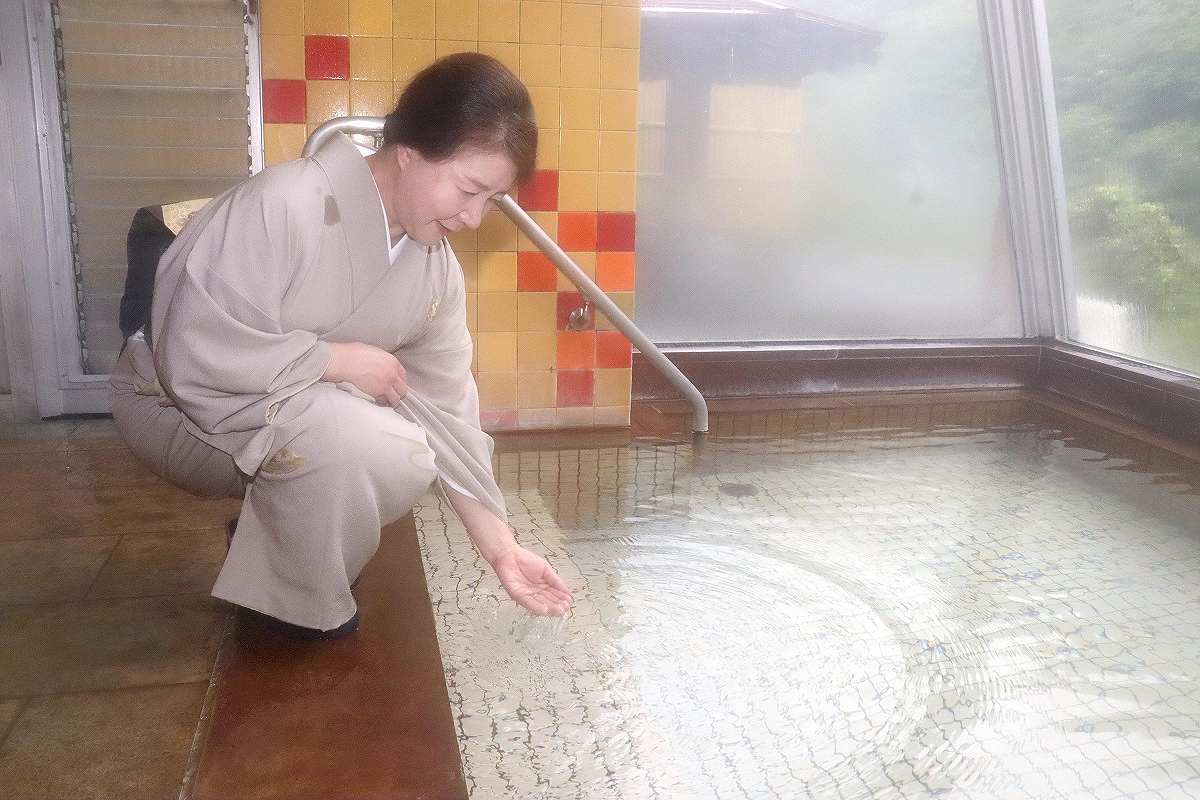
Rumiko Nakajima checks the hot spring water in a bathtub at her Hotel Kurobe in Kurobe, Toyama Prefecture. “The change in the composition of the onsen water has made me feel positive,” she said.
11:36 JST, June 12, 2024
KUROBE, Toyama — Following the Noto Peninsula Earthquake on Jan. 1, the chemical composition of the hot spring water at the Unazuki Onsen resort in Kurobe, Toyama Prefecture, was discovered to have changed, resulting in an increase in a substance that helps moisturize the skin.
“The earthquake caused a lot of cancellations for us, but this is an upside to it. We want to publicize this so we can revitalize our hot spring district,” a source connected to the local inn industry said.
Unazuki Onsen is one of the most popular hot spring resorts in Toyama Prefecture. The spring water is weakly alkaline and the temperature of the spring is about 90 C. The resort first opened in 1923 as a recreational facility for laborers working on a local power plant project.
“I’ve lived at this hot spring resort for more than 20 years, but this is the first time the composition of the water has ever changed. I couldn’t believe the earthquake did this!” said Rumiko Nakajima, 53, the proprietress of Hotel Kurobe (part of Unazuki Onsen), not hiding her surprise.
It was two days after the quake when Nakajima noticed something was different about the hot spring water, she says. When she soaked in it, she felt it was thicker than usual, seeming to wrap itself around her body. A few days later, the tiles in the main bathing areas suddenly began to turn brownish.
Around the same time, the office that manages the resort’s hot spring source heard from many local inns that their hot spring water developed a color and looked unusual.
The inns in Unazuki Onsen get their hot spring water from a roughly seven-kilometer system of pipes linking them to the Kuronagi Onsen hot spring, upstream on the Kurobe River.
According to Fujio Hyakkoku, 55, director of the management office, the water at the spring is clear and colorless, the same as before the quake, and also unchanged in temperature and volume. The pipe system was not damaged by the quake.
He said, “It was a mystery why the color of the water changed after it reached the inns.”
The office then asked the Toyama Prefectural Institute of Public Health to analyze the water’s composition.
A water sample was taken on Jan. 31 at the point where the hot water is distributed to the inns, and the analysis showed that the manganese ion content per kilogram of hot spring water was 0.3 milligrams, 75 times higher than in the previous analysis, performed in 2014. The brown coloration is believed to be caused by a chemical reaction between manganese and the chlorine the inns use to disinfect the water.
The analysis also showed that the level of metasilicic acid, which has a moisturizing effect and is therefore included in skin lotions and similar products, had more than quadrupled to 120.1 milligrams from 26.9 milligrams in 2014.
According to a cooperative association of inns in the Unazuki Onsen resort, reservations for 4,571 people, or 30% of the total number made at its member inns in January, were canceled, resulting in a loss of 95.43 million yen.
Nakajima said with a smile: “Our hot water supply never stopped [after the quake]. We also have some new advertising fodder. I’m a little more positive now.”
There is precedent for the composition of hot spring water changing after an earthquake.
At the Akiha spa Casui in Niigata, crystallized sand-like particles began to accumulate on the bottom of the bathtub after the 2004 Niigata Prefecture Chuetsu Earthquake. An analysis of the water revealed that the concentration of calcium ions and hydrogen carbonate ions had increased significantly.
Hideo Takizawa, head of the research department at the Hot Spring Research Center, Japan, said: “During an earthquake, groundwater pressure can fluctuate, which may affect hot springs. In the case of Unazuki, fluctuations in groundwater pressure may have changed how the water mixes, affecting its chemical composition.”





Most Read
Most read in the last 24 hours
-

Stepfather Reportedly Admits to Killing 11-Year-Old Boy Who Went ...
-

Dead Boy's Stepfather Confessed to Killing, Police Say; Victim's ...
-

Japan’s Coffee Bean Production Looks to Northern Areas to Expand ...
-

4 Injured as Pipe Bursts at Semiconductor-Related Company’s Facto...
-

Osaka Tax Official Leaks Data to Scammers Impersonating Police Of...
-

Cherry Blossoms in Full Bloom Across Iwate Prefecture, Bringing S...
-

Sexual Abuse Allegations Are Spurring Calls for a Broader Reckoni...
-

Stable Imperial Succession: Debate the Issue without Excluding Fe...
Most read in the last 7 days
-
Police Find Child's Shoe During Search for Missing Boy in Nantan,...
-
Body Found in Nantan, Kyoto Prefecture, During Search for 11-Year...
-
Japanese Prime Minister Takaichi Speaks to Pakistani Prime Minist...
-

Kyoto Police Arrests Father of 11-Year-Old Boy on Suspicion of Ab...
-

Body Found in Kyoto Pref. Forest Confirmed to Be Missing 11-Year-...
-
Strong Typhoon Sinlaku Heading Toward Tokyo's Ogasawara Islands
-

No Clear Plan for Expo Site 6 Months After Close; Delays, Unpaid ...
-
Stepfather Reportedly Admits to Killing 11-Year-Old Boy Who Went ...
Most read in the last 30 days
-
Mathematician Heisuke Hironaka, Winner of Fields Medal, Dies at 9...
-
Police Find Child's Shoe During Search for Missing Boy in Nantan,...
-
Body Found in Nantan, Kyoto Prefecture, During Search for 11-Year...
-

Cherry Blossoms, Rapeseed Flowers Perform Colorful ‘Duet’ in Niig...
-
New Bird Species Confirmed in Japan for 1st Time in 45 Years, Fou...
-
Nori Prices Surge in Japan Due to Poor Seaweed Production Amid Ri...
-

Earthquake Jolts Kansai Region, Recording Magnitude 4.2, Japanese...
-

Cherry Blossoms in Full Bloom Draw Crowds in Sendai, Miyagi Pref....
Top Articles in Society
-
Police Find Child’s Shoe During Search for Missing Boy in Nantan, Kyoto Prefecture
-
Body Found in Nantan, Kyoto Prefecture, During Search for 11-Year-Old Boy in Area (Update 1)
-
Cherry Blossoms, Rapeseed Flowers Perform Colorful ‘Duet’ in Niigata
-
New Bird Species Confirmed in Japan for 1st Time in 45 Years, Found on Tokara Islands in Kagoshima Pref.
-
Earthquake Jolts Kansai Region, Recording Magnitude 4.2, Japanese Seismic Intensity Scale 3
JN ACCESS RANKING
-
Police Find Child’s Shoe During Search for Missing Boy in Nantan, Kyoto Prefecture
-
Body Found in Nantan, Kyoto Prefecture, During Search for 11-Year-Old Boy in Area (Update 1)
-
Cherry Blossoms, Rapeseed Flowers Perform Colorful ‘Duet’ in Niigata
-
New Bird Species Confirmed in Japan for 1st Time in 45 Years, Found on Tokara Islands in Kagoshima Pref.
-
Nori Prices Surge in Japan Due to Poor Seaweed Production Amid Rising Sea Temps; Price of Onigiri Rice Balls Also Impacted
Most read in the last 24 hours
-
Stepfather Reportedly Admits to Killing 11-Year-Old Boy Who Went ...
-
Dead Boy's Stepfather Confessed to Killing, Police Say; Victim's ...
-
Japan’s Coffee Bean Production Looks to Northern Areas to Expand ...
-
4 Injured as Pipe Bursts at Semiconductor-Related Company’s Facto...
-
Osaka Tax Official Leaks Data to Scammers Impersonating Police Of...
Most read in the last 7 days
-
Police Find Child's Shoe During Search for Missing Boy in Nantan,...
-
Body Found in Nantan, Kyoto Prefecture, During Search for 11-Year...
-
Japanese Prime Minister Takaichi Speaks to Pakistani Prime Minist...
-
Kyoto Police Arrests Father of 11-Year-Old Boy on Suspicion of Ab...
-
Body Found in Kyoto Pref. Forest Confirmed to Be Missing 11-Year-...
Most read in the last 30 days
-
Mathematician Heisuke Hironaka, Winner of Fields Medal, Dies at 9...
-
Police Find Child's Shoe During Search for Missing Boy in Nantan,...
-
Body Found in Nantan, Kyoto Prefecture, During Search for 11-Year...
-
Cherry Blossoms, Rapeseed Flowers Perform Colorful ‘Duet’ in Niig...
-
New Bird Species Confirmed in Japan for 1st Time in 45 Years, Fou...