
Invisible threats / Enhanced capabilities needed to protect Japan’s key infrastructure

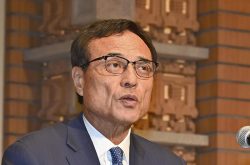
Shigeru Kitamura, former secretary general of the National Security Secretariat
18:45 JST, March 4, 2022
This is the ninth and final installment of a series exploring Japan’s vulnerabilities in areas such as information and supply networks, which have prompted the government to expedite efforts to pass a law to safeguard the nation’s economic security. The following is excerpted from an interview with Shigeru Kitamura, former secretary general of the National Security Secretariat.
Japan’s legal systems concerning national security have been developed gradually since the second Abe Cabinet, led by then-Prime Minister Shinzo Abe.
To use the human body as a reference, the country’s nervous system has been beefed up with the Law on the Protection of Specially Designated Secrets, which protects important information concerning national security. Its skeletal structures and muscles have been strengthened through the security-related laws, which enable among other things the limited exercise of the nation’s right of collective self-defense.
The legislation for the promotion of economic security, which the government approved at a Cabinet meeting on Feb. 25, is designed to strengthen the nation’s internal organs, so to speak, in the sense that it would strengthen the protection of business projects and companies that make up our society. With the enactment of the legislation, Japan will at last obtain a level of resilience equal to that of foreign nations, thus moving closer to being a “normal country” in that regard.
In modern times, so-called hybrid warfare is being fought, employing a combination of military and nonmilitary means. As illustrated by the cyber-attacks on financial institutions in Ukraine, made before Russia’s invasion of that country, vulnerable parts of countries’ key infrastructure are being struck.
Japan has taken its own measures to safeguard its governmental organizations, but the pre-screenings by the government included in the latest legislation will enhance its ability to defend key infrastructure. Situations such as key infrastructure suddenly ceasing to function, plunging Japan’s entire society into turmoil, must be avoided by all means.
One issue that needs to be discussed in the future is a “security clearance system,” which would allow classified information to be accessed only by parties who are deemed to pose no risk of leaks and is meant for conducting advanced joint research with other countries, including the United States.
For such a system to be meaningful, Japan must prepare a framework that is acceptable not only in this country but is also as stringent as similar systems elsewhere, such as in the United States. Whether such a system can be adopted in Japan depends on the maturity of the arguments for it within business circles, and by extension among the public.
The United States focuses on economic security in its National Security Strategy, the guiding principles for its diplomatic, military, and economic policies. In Japan’s National Security Strategy, the basic guidelines of the country’s security policy and which the government will amend at the end of this year, Japan must position clearly its efforts so far, the achievements contained in the legislation, and its future course of action regarding economic security.
Kitamura graduated from the Faculty of Law of the University of Tokyo and joined the National Police Agency in 1980. He became director of Cabinet Intelligence in 2011, and secretary general of the National Security Secretariat in 2019. In April 2020, he inaugurated an economic division in the National Security Secretariat. He is 65.





Most Read
Most read in the last 24 hours
-

Stepfather Reportedly Admits to Killing 11-Year-Old Boy Who Went ...
-

Dead Boy's Stepfather Confessed to Killing, Police Say; Victim's ...
-

Japan’s Coffee Bean Production Looks to Northern Areas to Expand ...
-

4 Injured as Pipe Bursts at Semiconductor-Related Company’s Facto...
-

Osaka Tax Official Leaks Data to Scammers Impersonating Police Of...
-

Cherry Blossoms in Full Bloom Across Iwate Prefecture, Bringing S...
-

Sexual Abuse Allegations Are Spurring Calls for a Broader Reckoni...
-

Stable Imperial Succession: Debate the Issue without Excluding Fe...
Most read in the last 7 days
-
Police Find Child's Shoe During Search for Missing Boy in Nantan,...
-
Body Found in Nantan, Kyoto Prefecture, During Search for 11-Year...
-
Japanese Prime Minister Takaichi Speaks to Pakistani Prime Minist...
-

Kyoto Police Arrests Father of 11-Year-Old Boy on Suspicion of Ab...
-

Body Found in Kyoto Pref. Forest Confirmed to Be Missing 11-Year-...
-
Strong Typhoon Sinlaku Heading Toward Tokyo's Ogasawara Islands
-

No Clear Plan for Expo Site 6 Months After Close; Delays, Unpaid ...
-
Stepfather Reportedly Admits to Killing 11-Year-Old Boy Who Went ...
Most read in the last 30 days
-
Mathematician Heisuke Hironaka, Winner of Fields Medal, Dies at 9...
-
Police Find Child's Shoe During Search for Missing Boy in Nantan,...
-
Body Found in Nantan, Kyoto Prefecture, During Search for 11-Year...
-

Cherry Blossoms, Rapeseed Flowers Perform Colorful ‘Duet’ in Niig...
-

New Bird Species Confirmed in Japan for 1st Time in 45 Years, Fou...
-

Nori Prices Surge in Japan Due to Poor Seaweed Production Amid Ri...
-

Earthquake Jolts Kansai Region, Recording Magnitude 4.2, Japanese...
-

Cherry Blossoms in Full Bloom Draw Crowds in Sendai, Miyagi Pref....
Top Articles in Politics
-

Glimpse into China’s Decision-Making Process Over Japanese Prime Minister Sanae Takaichi’s Taiwan Remark
-

Ritsumeikan Asia Pacific University Stripped of Certification for Simplified Visa Procedures Due to Document Failure
-

Japan’s PM Takaichi Seeks to Advance Policies Bearing Her Own ‘Color,’ Eyes Amending Constitution, Building Strong Economy
-

China Likely Launched Large-Scale Cognitive Warfare Campaign Over Takaichi’s Taiwan Remark
-

Japan Begins Releasing Oil from National Reserves in Response to Iran War to Stabilize Domestic Supply
JN ACCESS RANKING
-
Police Find Child’s Shoe During Search for Missing Boy in Nantan, Kyoto Prefecture
-
Body Found in Nantan, Kyoto Prefecture, During Search for 11-Year-Old Boy in Area (Update 1)
-
Cherry Blossoms, Rapeseed Flowers Perform Colorful ‘Duet’ in Niigata
-
New Bird Species Confirmed in Japan for 1st Time in 45 Years, Found on Tokara Islands in Kagoshima Pref.
-
Nori Prices Surge in Japan Due to Poor Seaweed Production Amid Rising Sea Temps; Price of Onigiri Rice Balls Also Impacted
Most read in the last 24 hours
-
Stepfather Reportedly Admits to Killing 11-Year-Old Boy Who Went ...
-
Dead Boy's Stepfather Confessed to Killing, Police Say; Victim's ...
-
Japan’s Coffee Bean Production Looks to Northern Areas to Expand ...
-
4 Injured as Pipe Bursts at Semiconductor-Related Company’s Facto...
-
Osaka Tax Official Leaks Data to Scammers Impersonating Police Of...
Most read in the last 7 days
-
Police Find Child's Shoe During Search for Missing Boy in Nantan,...
-
Body Found in Nantan, Kyoto Prefecture, During Search for 11-Year...
-
Japanese Prime Minister Takaichi Speaks to Pakistani Prime Minist...
-
Kyoto Police Arrests Father of 11-Year-Old Boy on Suspicion of Ab...
-
Body Found in Kyoto Pref. Forest Confirmed to Be Missing 11-Year-...
Most read in the last 30 days
-
Mathematician Heisuke Hironaka, Winner of Fields Medal, Dies at 9...
-
Police Find Child's Shoe During Search for Missing Boy in Nantan,...
-
Body Found in Nantan, Kyoto Prefecture, During Search for 11-Year...
-
Cherry Blossoms, Rapeseed Flowers Perform Colorful ‘Duet’ in Niig...
-
New Bird Species Confirmed in Japan for 1st Time in 45 Years, Fou...