

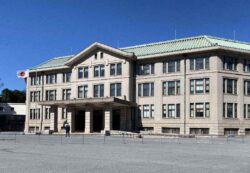
The Finance Ministry’s headquarters building in Tokyo.
15:40 JST, December 16, 2020
The time has come for the government to think calmly about how to bring an extraordinary budget, crafted amid the extraordinary time of the coronavirus pandemic, back to a normal state.
For creating additional economic stimulus measures, the tide changed in late November when the Cabinet Office released estimates.
According to the estimates, the nation’s economy had a shortfall in demand of ¥34 trillion because of a downturn in the July-September quarter. These estimates prompted the ruling camp to call for the government to compile another major supplementary budget to fill this gap.
It is easier for lawmakers to gain public support if they help increase budget expenditures than reduce them. This sounds even more true for lawmakers who are thinking about the House of Representatives election due next year.
The Finance Ministry was reluctant for an additional drastic increase in budget expenditures, saying the government had already taken enough measures to address the demand shortfall through two supplementary budgets for fiscal 2020. However, this notion was not heeded.
In the end, the additional economic package has been decided in which fiscal spending by the central and local governments totals ¥40 trillion, higher than the ¥34 trillion initially discussed.
However, it is difficult to accurately measure a demand shortfall. The Cabinet Office and the Bank of Japan have released estimates on this issue, which show huge differences from each other. Perhaps lawmakers and officials did not account for this aspect in discussing the additional economic package.
Moreover, the ¥40 trillion of fiscal spending includes ¥5 trillion in the remainder of reserve funds for the current fiscal year, which ends in March, as well as another ¥5 trillion in reserve funds that will be earmarked in an initial budget bill for fiscal 2021. This means that fiscal spending is ballooning through reserve funds whose spending purposes have not been decided.
It is understandable that the additional economic package focuses on strengthening medical services and helping to maintain employment.
On the other hand, it also includes projects to encourage decarbonization and digitization, with related spending having been earmarked in a bill for a third supplementary budget for fiscal 2020.
These policies are favorable on their own, but spending for lesser urgent projects should have been included in the initial budget for the next fiscal year so that the Diet can have careful discussions on these issues. Rigorous scrutiny is essential to ensure that there is no spending in the heat of the moment.
By compiling three supplementary budgets, it is expected that the general account spending for the current fiscal year will swell to ¥175 trillion, with the issuance of government bonds to reach an unprecedented ¥112 trillion, a record high for a fiscal year. This massive debt will be passed down to the younger generations.
Since the BOJ has been buying a large amount of government bonds, their prices won’t fall with interest rates remaining at almost zero, no matter how many have been issued. Consequently, fiscal discipline tends to be lacking. The government and the ruling camp should be aware of these risks.







Most Read
Most read in the last 24 hours
-

Dead Boy's Stepfather Confessed to Killing, Police Say; Victim's ...
-
Japan’s Coffee Bean Production Looks to Northern Areas to Expand ...
-

4 Injured as Pipe Bursts at Semiconductor-Related Company’s Facto...
-

Osaka Tax Official Leaks Data to Scammers Impersonating Police Of...
-

Stable Imperial Succession: Debate the Issue without Excluding Fe...
-

Sexual Abuse Allegations Are Spurring Calls for a Broader Reckoni...
-

New Robotics Center to Conduct Experiments Around the Clock; New ...
-
Imperial Household Agency Presses for ‘Urgent’ Debate to Stabiliz...
Most read in the last 7 days
-
Police Find Child's Shoe During Search for Missing Boy in Nantan,...
-
Body Found in Nantan, Kyoto Prefecture, During Search for 11-Year...
-
Japanese Prime Minister Takaichi Speaks to Pakistani Prime Minist...
-

Kyoto Police Arrests Father of 11-Year-Old Boy on Suspicion of Ab...
-

Body Found in Kyoto Pref. Forest Confirmed to Be Missing 11-Year-...
-
Strong Typhoon Sinlaku Heading Toward Tokyo's Ogasawara Islands
-

Stepfather Reportedly Admits to Killing 11-Year-Old Boy Who Went ...
-

No Clear Plan for Expo Site 6 Months After Close; Delays, Unpaid ...
Most read in the last 30 days
-
Mathematician Heisuke Hironaka, Winner of Fields Medal, Dies at 9...
-
Police Find Child's Shoe During Search for Missing Boy in Nantan,...
-
Body Found in Nantan, Kyoto Prefecture, During Search for 11-Year...
-

Cherry Blossoms, Rapeseed Flowers Perform Colorful ‘Duet’ in Niig...
-

New Bird Species Confirmed in Japan for 1st Time in 45 Years, Fou...
-
Nori Prices Surge in Japan Due to Poor Seaweed Production Amid Ri...
-

Earthquake Jolts Kansai Region, Recording Magnitude 4.2, Japanese...
-

Cherry Blossoms in Full Bloom Draw Crowds in Sendai, Miyagi Pref....
Top Articles in Politics
-

Glimpse into China’s Decision-Making Process Over Japanese Prime Minister Sanae Takaichi’s Taiwan Remark
-
Ritsumeikan Asia Pacific University Stripped of Certification for Simplified Visa Procedures Due to Document Failure
-

Japan’s PM Takaichi Seeks to Advance Policies Bearing Her Own ‘Color,’ Eyes Amending Constitution, Building Strong Economy
-
China Likely Launched Large-Scale Cognitive Warfare Campaign Over Takaichi’s Taiwan Remark
-
Japan Begins Releasing Oil from National Reserves in Response to Iran War to Stabilize Domestic Supply
JN ACCESS RANKING
-
Police Find Child’s Shoe During Search for Missing Boy in Nantan, Kyoto Prefecture
-
Body Found in Nantan, Kyoto Prefecture, During Search for 11-Year-Old Boy in Area (Update 1)
-
Cherry Blossoms, Rapeseed Flowers Perform Colorful ‘Duet’ in Niigata
-
New Bird Species Confirmed in Japan for 1st Time in 45 Years, Found on Tokara Islands in Kagoshima Pref.
-
Nori Prices Surge in Japan Due to Poor Seaweed Production Amid Rising Sea Temps; Price of Onigiri Rice Balls Also Impacted
Most read in the last 24 hours
-
Dead Boy's Stepfather Confessed to Killing, Police Say; Victim's ...
-
Japan’s Coffee Bean Production Looks to Northern Areas to Expand ...
-
4 Injured as Pipe Bursts at Semiconductor-Related Company’s Facto...
-
Osaka Tax Official Leaks Data to Scammers Impersonating Police Of...
-
Stable Imperial Succession: Debate the Issue without Excluding Fe...
Most read in the last 7 days
-
Police Find Child's Shoe During Search for Missing Boy in Nantan,...
-
Body Found in Nantan, Kyoto Prefecture, During Search for 11-Year...
-
Japanese Prime Minister Takaichi Speaks to Pakistani Prime Minist...
-
Kyoto Police Arrests Father of 11-Year-Old Boy on Suspicion of Ab...
-
Body Found in Kyoto Pref. Forest Confirmed to Be Missing 11-Year-...
Most read in the last 30 days
-
Mathematician Heisuke Hironaka, Winner of Fields Medal, Dies at 9...
-
Police Find Child's Shoe During Search for Missing Boy in Nantan,...
-
Body Found in Nantan, Kyoto Prefecture, During Search for 11-Year...
-
Cherry Blossoms, Rapeseed Flowers Perform Colorful ‘Duet’ in Niig...
-
New Bird Species Confirmed in Japan for 1st Time in 45 Years, Fou...